Get Full Government Meeting Transcripts, Videos, & Alerts Forever!
Get email alerts on the Pipeline Safety topic
No spam. Unsubscribe anytime.
Iroquois liaison briefs Columbia County LEPC on pipeline safety, local assets and responder procedures
Summary
An Iroquois emergency-response liaison told the Columbia County Local Emergency Planning Committee about pipeline operations, local mainline valves and first-responder procedures, and said planned compressor additions elsewhere would not affect Columbia County; the committee approved prior minutes and adjourned.
Nicholas, an emergency-response liaison for the Iroquois pipeline, briefed the Columbia County Local Emergency Planning Committee on the company’s operations, safety features and procedures first responders should follow when called to pipeline incidents.
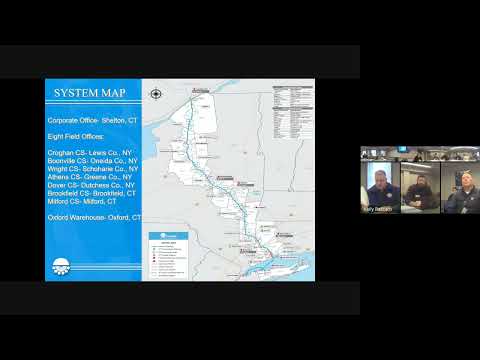
The presentation, delivered with maps and handouts, outlined the pipeline’s route from Saint Lawrence County through Columbia County and into Connecticut and Long Island, the company’s remote valve controls and its emergency-response priorities. Nicholas said Iroquois operates a 24/7 gas-control center in Shaw, Connecticut, and can close mainline valves remotely in roughly 15–18 seconds.
Why it matters: the pipeline crosses populated and rural areas of Columbia County, and local fire, sheriff and state police agencies are the first on scene for any reported leak or incident. The company emphasized training, coordination and public awareness tools for responders and residents.
Nicholas gave specific guidance for initial on-scene actions: “call gas control as your first call so they can get the ball rolling on our side of things to get someone out there to diagnose the issue,” and said responders should eliminate ignition sources, evacuate upwind, triage injuries and set up a command post. He added a commonly used field rule: “If it’s too hot, you’re too close, and if it’s too loud, you’re too close.”
He explained technical safeguards that reduce the likelihood of a catastrophic failure: Iroquois runs inline inspection devices — often called smart pigs — through the pipeline every five to seven years to check wall thickness, corrosion and dents; the company also hydrostatically tests pipe segments to 150% of operating pressure over a 24-hour period. Nicholas described other measures including automatic mainline valves, emergency shutdown (ESD) buttons on compressor sites, perimeter alarms and camera systems.
On local assets, Nicholas identified two mainline valves in Columbia County (valve numbers 18 and 19) and noted pipeline markers and a public online resource, the National Pipeline Mapping System (NPMS), which residents and officials can use to view pipeline locations and operator contact information.
Nicholas also discussed the EXC expansion-by-compression project and said the company’s permitting work to add compressors is focused on Dover, Athens and Brookfield and that, per the presentation, “we’re not doing anything in Columbia County” as part of that project. He emphasized the planned work would remain within existing fenced sites and that permitting was ongoing.
The liaison outlined company staffing and response commitments: Iroquois runs about 414 miles of pipeline through the region, employs about 90 people, has seven compressor stations (about 120,000 total horsepower), and uses a roster of field technicians who aim to be within roughly an hour of assigned areas when dispatched. Nicholas said some remote communications use satellite and that gate and valve controllers provide multiple fail-safes.
Committee business: earlier in the meeting the committee moved and approved the minutes from Aug. 20; the meeting concluded after committee reports and an adjournment motion that was seconded and approved.
Next steps: Nicholas offered to meet with local fire companies and other first responders for on-site briefings and trainings and provided contact information for follow-up questions.