Get Full Government Meeting Transcripts, Videos, & Alerts Forever!
Get email alerts on the Early Childhood Policy topic
No spam. Unsubscribe anytime.
Senate Finance Committee favorably reports Substitute House Bill 7 after testimony on early‑childhood mental health and home visiting
Summary
The Senate Finance Committee adopted Amendment 3121 and voted to favorably report Substitute House Bill 7 (Strong Foundations Act) after witnesses urged adoption of DC:0-5 diagnostic codes, Medicaid reimbursement pathways for infant mental‑health services, and strengthened home visiting supports; the committee deferred appropriations to the next budget.
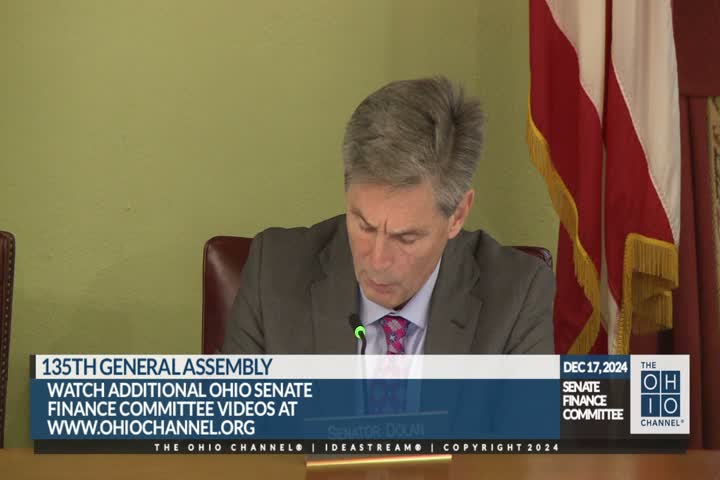
Chairman Dolan convened the Ohio Senate Finance Committee and called up Substitute House Bill 7, the Strong Foundations Act, for its third hearing and consideration under Amendment 3121.
The chair explained Amendment 3121 (effectively dash‑15) narrows some provisions from earlier drafts, makes changes to childcare registration and licensing effective July 1, 2025, clarifies that agencies should propose strategies rather than receive mandates that obligate immediate funding, and removes a provision allowing telehealth home visits. "So there'll be no Zoom home visits," the chair said, adding that the committee wants to confirm Help Me Grow is producing intended outcomes before allowing remote visits to substitute for in‑person nursing home visits.
Sen. Hicks Hudson questioned the amendment, asking for the rationale behind the July 1, 2025 start date, expressing concern that banning telehealth could limit access for some families, and objecting to the removal of doulas from Department of Rehabilitation programming. "I'm concerned that we are stepping back from a really great opportunity to move the needle on all of these areas," Hicks Hudson said. Chairman Dolan responded that the doula provision and several other items had been removed earlier because the bill in prior form would have required about $35,000,000 in spending; he said funding decisions will be made during the next General Assembly's budget process.
The committee heard supportive testimony from three witnesses. Kathleen Feldman of Groundwork Ohio urged adoption of the DC:0-5 diagnostic framework for infants and toddlers, arguing it would create age‑appropriate diagnostic criteria and "open new pathways for Medicaid reimbursement" for caregiver‑child therapy and other early‑childhood mental‑health services. Feldman said the bill also prioritizes home visiting resources for families at greatest risk and encourages interagency collaboration to address Ohio's infant‑mortality challenges.
Danielle Tong, executive director of Celebrate 1, described personal experiences with pregnancy complications and cited state statistics, saying the bill could help reduce the economic and health impacts of prematurity. "Substitute House Bill 7, as currently written, takes important steps towards preventing adverse birth outcomes for Ohio's most vulnerable residents," Tong said, and called for modernizing WIC, improving access to affordable child care, and stronger coordination across systems.
Dustin McKee, CEO of the Ohio Psychological Association, also endorsed the bill's DC:0-5 provisions, describing how the supplemental diagnostic set maps to ICD‑10 codes and can be crosswalked in Medicaid programs to enable more accurate diagnoses and treatment for very young children.
Following testimony, Sen. Serino moved to favorably report Substitute House Bill 7 to the committee on rules and reference. The clerk called the roll and members responded in the affirmative; the chair announced the bill was favorably reported and that the roll would remain open for one hour after the committee. The committee recessed at the call of the chair.
The committee's action forwarded the amended substitute to rules and reference; funding for any new slots created by the bill, the chair said, will be decided in the next budget cycle. The committee did not adopt telehealth home visits and removed several appropriation items from the current draft, positions the chair described as deferring spending decisions rather than rejecting program approaches.
Notes: The hearing focused on program design, diagnostic coding (DC:0‑5), Medicaid reimbursement pathways, home visiting services (Help Me Grow), and the timing of any funding for added child‑care slots. The committee recorded a favorable report and left appropriations decisions to the budget process.