Get Full Government Meeting Transcripts, Videos, & Alerts Forever!
Get email alerts on the House Bill 7 topic
No spam. Unsubscribe anytime.
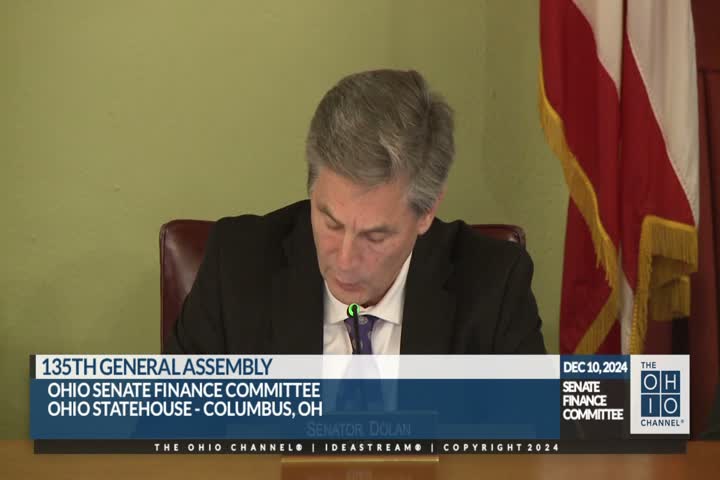
Senate Finance Committee hears sponsor testimony on substitute House Bill 7 targeting early-childhood services
Summary
Sponsors told the Senate Finance Committee the substitute for House Bill 7 focuses on early-childhood mental health, WIC modernization, coordinated services and targeted home visiting; the committee adopted amendment 0633-12 to make the substitute the working document.
Representative Andrew White presented sponsor testimony on substitute House Bill 7, telling the Senate Finance Committee the bill refocuses efforts on children's first 1,000 days and includes measures to align early-childhood mental-health diagnostic codes, require evaluation and reporting, modernize WIC enrollment, improve interagency coordination and target home visiting to highest-risk families.
The sponsor said the original funding request could not be carried forward this session, noting, "We can't keep the $334,000,000 that we wanted to spend right now because it's coming to you so late," and characterized the substitute as a pared-back, still-purposeful package that preserves key policy changes and reporting requirements. He said the bill directs Medicaid recognition of early-childhood diagnostic classifications so diagnoses and services crosswalk as children age.
On WIC, the sponsor said the Department of Health had secured a $10,000,000 federal grant to modernize the program in two phases: an online-system study and later streamlined enrollment and card-loading practices. He noted only about 41% of eligible infants and children ages 0'5 currently use WIC and framed modernization as a way to increase participation and stretch public dollars.
The substitute also includes provisions to reduce administrative burdens on child-care providers (aligning state quality ratings with Head Start and national accreditation where possible), expand the pool of evidence-based providers and maximize reimbursement and funding options (including use of Medicaid and federal resources for peer-to-peer and other services). Sponsor testimony emphasized prioritizing home visiting for the most at-risk families and permitting virtual home visiting to expand reach in rural and urban areas with high infant mortality rates.
During questions, a committee member asked whether staff had identified how many Head Start, Early Head Start or nationally accredited centers remain outside the state's Step Up to Quality system; the sponsor said staff were collecting that data and would provide counts when available.
Procedurally, the chair moved amendment 0633-12 to make substitute House Bill 7 the working document; with no objection, the committee agreed to work from the substitute bill going forward. No final vote on passage was taken in committee during this hearing.