Get Full Government Meeting Transcripts, Videos, & Alerts Forever!
Get email alerts on the Energy Efficiency topic
No spam. Unsubscribe anytime.
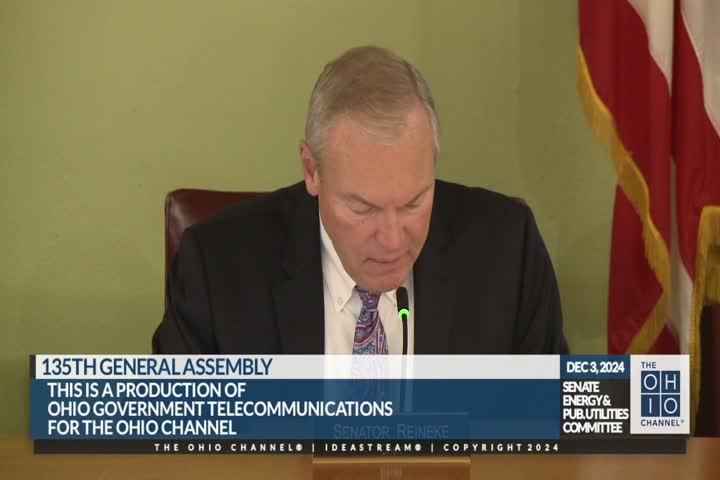
Ohio committee hears proponent testimony for voluntary utility energy-efficiency programs in HB 79
Summary
Supporters told the Senate Energy and Public Utilities Committee HB 79 would allow electric distribution utilities to offer voluntary, cost‑effective energy‑efficiency and smart‑technology programs (with consumer safeguards and low‑income provisions) intended to reduce peak demand and lower overall costs for customers.
Supporters of House Bill 79 told the Ohio Senate Energy and Public Utilities Committee that the bill would allow electric distribution utilities to voluntarily offer customer programs aimed at reducing wasted electricity, lowering bills for participating customers, and cutting systemwide costs by reducing peak demand.
Robert Kelter, managing attorney at the Environmental Law & Policy Center, testified that the programs in HB 79 are voluntary and include two opt‑outs for customers. He said the programs can lower market prices for electricity — citing a commission staff analysis that found prior programs reduced market price by about 5.7% — and that the bill includes consumer protections such as a prohibition on sending unsolicited energy‑saving kits to customers who do not request them.
AEP Ohio’s Brian Billing, director of customer experience, told the committee the bill sets up oversight and cost‑effectiveness checks. He said the legislation requires that overall savings exceed costs, provides Public Utilities Commission oversight to verify savings, establishes multiple cost caps to limit bill impacts, and supports dedicated programs for low‑income customers. Billing said the bill sets a reasonable annual energy‑savings target of at least 0.5% for EDUs within the bill’s cost caps.
Senator Brenner asked how much energy the programs would save; Billing estimated roughly 0.5% of peak capacity in an initial year and said cumulative savings stack over time as participation grows.
Will Baker, director of market innovation at Renew Home, described the potential for utility‑run programs to accelerate adoption of smart thermostats and create a “virtual power plant” of residential load flexibility. He estimated smart thermostats can save about 10–12% on heating and 15% on cooling for participating homes and pointed to recent PJM auction price spikes as context for the bill’s urgency.
Christopher Holland, senior counsel for AES Ohio, said the state’s electric distribution utilities are well positioned to deliver large‑scale, cost‑effective programs that coordinate contractors and local markets, and reiterated support for low‑income measures, smart‑technology provisions, and consumer protections included in HB 79.
The committee received additional written testimony and closed the second hearing; no formal vote on HB 79 occurred during the session.
The bill’s next procedural step will depend on the committee’s internal scheduling and any amendments the sponsors or members propose.