
Department of Taxation Seeks IT Staff, Scanner Replacements and Enforcement Capacity to Improve Collections
Get AI-powered insights, summaries, and transcripts
Subscribe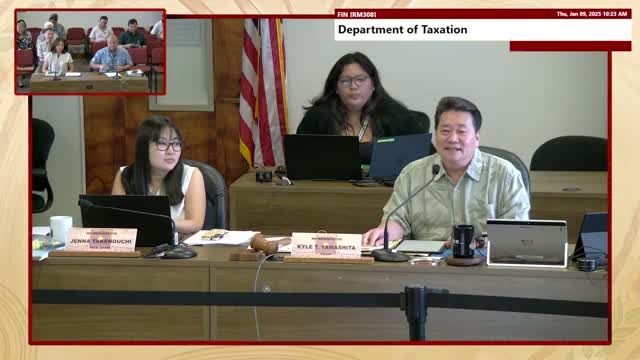
Summary
Department of Taxation officials told the House Finance Committee they collected about $10.25 billion in FY2024 and are requesting funds to maintain GenTax/TSM, replace scanners, pilot AI, hire IT personnel for IRS Direct File integration, add a data privacy officer and expand enforcement capacity.
A Department of Taxation official (unnamed in the transcript) told the House Committee on Finance the department collected approximately $10,250,000,000 in state tax revenues in fiscal year 2024, processed more than 2.8 million electronically filed returns and handled roughly 350,000 paper returns.
To sustain operations and build capacity the department requested several items in its biennial budget: $750,000 in fiscal 2027 to replace paper scanners reaching end of life for its Computerized Tax Administration System (TSM/GenTax); $100,000 annually for AI consultation and product trials to explore process improvements; and seven permanent positions within its IT Services Office to build and maintain an online filing platform that would integrate with the IRS Direct File program.
The department said two additional exempt senior software developer roles would help retain in-house talent and reduce reliance on external contractors for large system changes. It also proposed a data privacy officer in the Director’s office to meet IRS privacy and data-sharing requirements and two new Kauai positions (an auditor and administrative assistant) to expand on-island audit capacity.
The department highlighted its Special Enforcement Section (SES), credited with collecting over $54,000,000 last year, and requested an SES Senior Investigator and administrative assistant to support civil investigations of noncompliance. The department said seasoned auditors can often generate substantial assessments and described a rough rule-of-thumb that an experienced auditor might assess about $2,000,000 annually, though that outcome is not guaranteed.
Committee members pressed on return-on-investment and cost questions. The department said operating costs last fiscal year were around $30,000,000 and cited a per-dollar cost of collection of roughly 29 cents per $100 collected; staff later noted total base budgets this fiscal year were approximately $42,500,000. On the Council on Revenues forecasting changes, economist Seth Kobe explained small downward adjustments reflected an outsized estate-tax payment and a moderation from an earlier optimistic forecast.
Members asked about coordination with the state CIO and ETS on hiring developers; department staff said DOTAX developers work independently but participate in statewide staffing and retention discussions.
The department offered to follow up with more detailed cost and ROI estimates and to provide the committee with requested materials.