Get Full Government Meeting Transcripts, Videos, & Alerts Forever!
Get email alerts on the Parental Rights Education topic
No spam. Unsubscribe anytime.
Debate over 'parents' bill of rights' centers on curriculum, release time and disclosure for students
Summary
Amended House Bill 8 drew dozens of in‑person witnesses for and against provisions that define core curriculum, expand religious release time rules and require parental notification of certain student disclosures; opponents warned the bill's vague language about 'sensitive' or 'gender ideology' content could censor curriculum and force educators to disclose students' LGBT status to parents, posing safety risks.
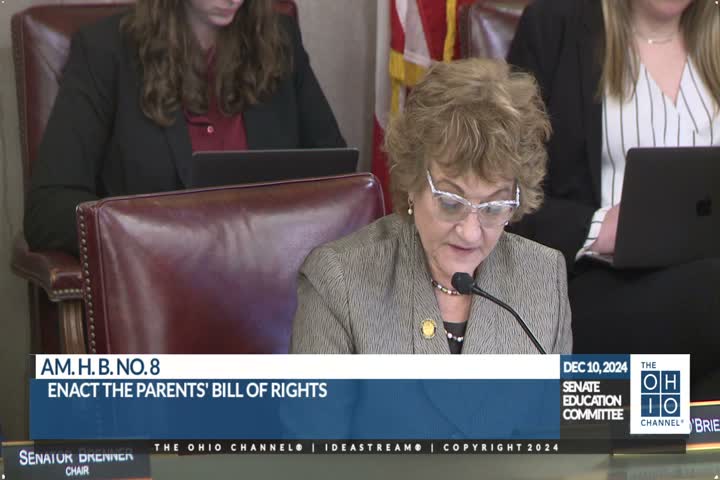
Amended House Bill 8, billed by sponsors as a "parents' bill of rights in education," prompted hours of public testimony and sustained debate in the Ohio Senate Education Committee over three core themes: required parental notification and disclosure obligations, the expansion and regulation of release‑time religious instruction (RTRI), and new definitions of "core" and "sensitive/**** content" in curriculum.
Supporters such as Kathleen Beyer told the committee the bill is necessary to ensure parental access and due process when parents feel excluded by school administrators. "Parents will have rights in education," Beyer said in her testimony, describing conflicts with a local district.
Opponents — including transgender advocates, educators, counselors and civil‑rights groups — said the bill's language is vague and risks harming vulnerable students. Mallory Golsky of Kaleidoscope Youth Center called the revised bill "a don't say gay bill," arguing that vague terms like "gender ideology" and "sensitive content" could be used to censor classroom materials and library books. Multiple witnesses recounted how forced disclosure of a student's gender identity or sexual orientation to parents could lead to family rejection, homelessness and mental‑health harms.
School leaders and professional groups raised practical and legal concerns. Witnesses from NASW Ohio, the Ohio Education Association, Ohio Federation of Teachers and school counseling associations pointed to duplicative statutory language, potential conflicts with FERPA and HIPAA, logistical challenges for RTRI (release and return processes) and the risk that mandatory disclosure requirements would undermine counselors' discretion to protect student welfare. "The bill's provision mandating the disclosure of a student's sexual orientation or gender identity to parents ... places educators in an untenable position," said a representative from Equality Ohio.
Committee debate also covered a series of amendments the ranking member proposed to add safeguards — for example, exceptions when disclosure would likely lead to abuse, requirements for criminal background checks for third‑party RTRI instructors, and limits on use of school resources for promotion of outside religious programs — many of which were moved and tabled during the session.
The hearing closed after dozens of in‑person testimonies and a list of written statements available on committee iPads; Chair Brenner adjourned the committee and left further legislative steps to the committee process.