Get Full Government Meeting Transcripts, Videos, & Alerts Forever!
Get email alerts on the Student Discipline topic
No spam. Unsubscribe anytime.
Ohio bill would let superintendents extend expulsions and set readmission conditions after violent incidents
Summary
House Bill 206 would allow a superintendent, working with a multidisciplinary team, to suspend an expelled student up to 180 days (with a possible 90‑day extension) when the student poses an imminent or severe danger; it requires written readmission criteria, a licensed mental‑health assessment and a continuing‑education plan during suspension.
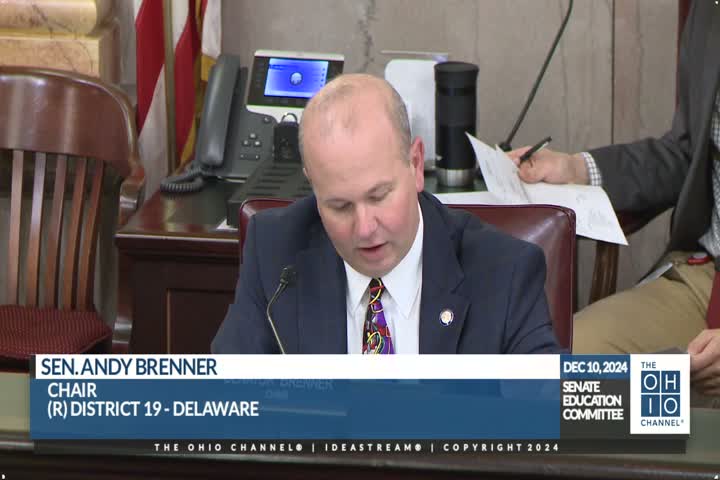
House Bill 206 would give local superintendents more discretion to protect students and staff after serious disciplinary incidents while creating a formal process for readmission, sponsors told the Senate Education Committee.
Representative Click, sponsor of HB 206, said the change was prompted by a December 6, 2022, incident in his district in which a 14‑year‑old brought a loaded handgun to school. "Current law prevents school authorities from acting on those warning signs," Click said, arguing districts lacked tools to keep students safe after expulsion. Under the bill, a superintendent, advised by a multidisciplinary team, could extend suspensions up to 180 days if the student is determined to pose an imminent or severe danger; the bill also allows an additional 90‑day extension if readmission criteria are not yet met.
The measure requires that the superintendent provide written criteria for reinstatement to the student and parents, and calls for a psychiatric or psychological assessment by a licensed professional to help determine whether the pupil remains an endangerment to others. Sponsors said the bill also mandates a plan for the continuing education of an expelled student during any extended suspension; for students with IEPs that timeline is shortened to conform with federal law.
Supporters including Laura Bryant, director of teaching and learning for Tiffin City Schools, argued the bill balances safety and educational continuity. "We need the ability to provide alternatives for education that don't necessarily always involve allowing a dangerous student to physically return to our buildings," Bryant told the committee, adding that districts currently have no plan for a student who can be out of school for a year with no education plan.
Committee members pressed sponsors about where students would be placed during long suspensions and whether indefinite or very long suspensions could raise constitutional concerns about access to public education. Sponsor testimony and proponent answers said placement could include district‑coordinated online programs or regional alternative schools and emphasized the bill requires a continuing‑education plan rather than leaving students entirely without services.
The committee closed the first hearing on HB 206 after sponsor and proponent testimony and several member questions. The bill will next follow the committee's regular process for further consideration.