Get Full Government Meeting Transcripts, Videos, & Alerts Forever!
Get email alerts on the Agriculture Policy topic
No spam. Unsubscribe anytime.
Senate panel adopts mens rea change to HB503 after farmer rebuts ban on garbage feeding
Summary
The Senate Agriculture and Natural Resources Committee adopted two amendments to amended substitute House Bill 503, shifting criminal penalties from strict liability to a 'knowingly' standard and revising definitions. Farmer Wayne Shingler testified in opposition, arguing the proposed ban on 'garbage feeding' is unnecessary and proposing regulatory carve-outs.
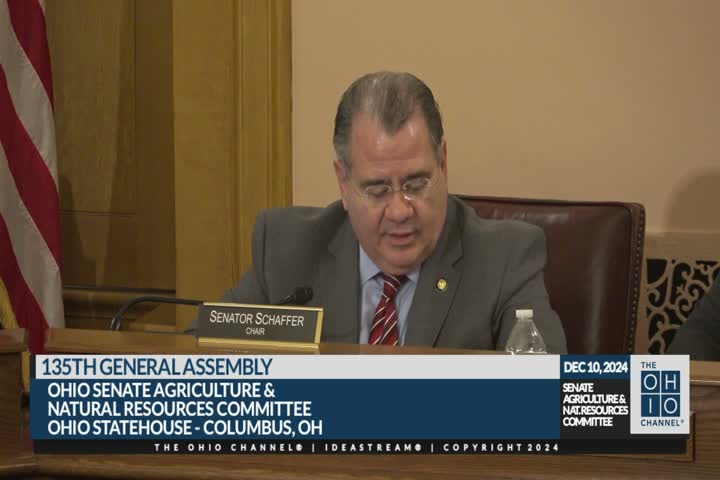
Chair Schafer convened the Senate Agriculture and Natural Resources Committee to consider amended substitute House Bill 503, which the panel amended and forwarded to the committee on rules and reference after public testimony and committee discussion.
Vice Chair Landis moved and explained two amendments to HB503. Amendment AM 1352746 changes criminal penalties in the bill by replacing a strict-liability mens rea standard with a requirement that the actor act “knowingly.” Amendment AM 1352819-2 updated the agricultural commodity handlers law by clarifying the definition of “storage” and adding definitions for “grain bank” and “regular bid price.” Members raised no objections and the committee adopted both amendments.
Farmer Wayne Shingler of Woodland Urban Farm LLC testified in opposition. Shingler said he is a Franklin County farmer and food-waste recycler and told the committee he intends to engage in cooked-food feeding of swine. He argued criminal penalties should be reserved for activities that create a clear public-welfare threat. “If criminal penalties are to be imposed on anyone engaging in a certain activity, it should only be because that activity threatens to cause serious harm,” Shingler said.
Shingler disputed the three rationales Representatives Jones and Peterson reportedly cited for a ban: that “nobody wants to do it,” that it risks spreading infectious disease, and that it attracts and sustains feral swine. On disease risks, he cited Ohio’s Chapter 942 requirement to boil swill for 30 minutes and told the committee he has reviewed studies (which he said are mostly from the National Institutes of Health) showing pathogens are inactivated at temperatures and times lower than that standard. “There are no instances of anyone causing a disease outbreak by complying with chapter 942,” he said.
On the claim that boiled swill would attract feral swine, Shingler told the committee that feral hogs will eat most of the same feeds as domestic swine and that the counties previously cited as having feral hog populations do not include Franklin County. He said he currently keeps two pigs for breeding and had postponed buying feeder pigs until he obtained a license.
Shingler also suggested the ban may be motivated by a desire to reduce the Department of Agriculture’s responsibilities rather than by public-health necessity. As an alternative, he recommended a regulatory model similar to Ohio Revised Code chapter 925—labeling rules and producer exemptions—and proposed a possible exemption threshold (for example, producers with fewer than 100 hogs) or a restriction limiting certain sales, akin to ORC 925.10.
After testimony concluded and with no further discussion, Vice Chair Landis moved that the committee favorably report the amended substitute HB503 to the committee on rules and reference. The clerk called the roll and the committee voted 5-0 to report the bill.
The committee’s action advances the amended measure to the committee on rules and reference; no final disposition by the full Senate was recorded during this hearing.