Get Full Government Meeting Transcripts, Videos, & Alerts Forever!
Get email alerts on the Compensation topic
No spam. Unsubscribe anytime.
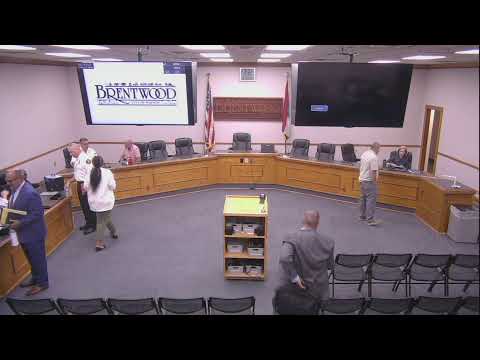
Brentwood presents pay study, board directs staff to cost patrol regrade; second reading set for Sept. 3
Summary
City consultants recommended moving nonuniform pay toward the 60th percentile, estimating roughly $983,000 in direct salary cost and about $1.45 million including benefits; the board instructed staff (7–1) to calculate the cost of moving patrol officers up one grade and scheduled a second reading for Sept. 3.
City staff and consultants presented a compensation study to the Board of Aldermen on Aug. 19 recommending the city move its nonuniformed pay philosophy to the 60th percentile and use a multi-year CPI mechanism to limit future drift.
Karen Campbell of GatePoint HR summarized the methodology used for the study, saying staff expanded their comparator pool, collected responses from 24 organizations, and used measures such as service offerings, local demographics and job-knowledge metrics to assign grades and steps. Campbell said the recommended move to the 60th percentile would prioritize raises for specific positions in stages and listed four prioritized groups of positions with corresponding cost buckets.
Campbell reported the total financial impact as presented in the meeting transcript as roughly $983,000 (the spoken transcript figure was ambiguous) and said the recommendation covered 119 positions. The mayor later noted that including benefits would increase the total cost to about $1.45 million.
Board debate and direction
Aldermen engaged in extended questions about wage compression, grade placements, and whether fire-protection comparators skewed firefighter pay grades versus patrol-officer grades. Alderman Plovka and others praised the committee work and the thoroughness of the consultant'driven analysis. Plovka urged the board to consider moving patrol officers up one grade (from U16 to U17), arguing the present two-grade differential between patrol officers and firefighter-paramedics sends the wrong signal.
After discussion, Alderman Plovka moved — and the board seconded — a motion directing staff to calculate the cost of moving patrol officers from grade U16 to U17 and report back at the Sept. 3 meeting. That motion passed, 7'to'1. The motion did not itself change payroll; it authorized staff modeling to produce a cost estimate to inform a possible future vote.
Funding questions
Several aldermen pressed staff about funding the recommended compensation changes. Staff described a scenario using Economic Development Sales Tax (EDST) revenue, and attendees discussed a proposal to divert $1,000,000 per year from the EDST fund as part of a multi-year affordability plan. Some aldermen expressed concern about repurposing EDST revenue; staff and the city attorney said their modeling shows the city can continue to meet existing debt-service obligations while setting aside recurring EDST funds and maintaining reserves.
Public comment and pension context
Resident Andy Hartnett told the board his personal medical emergency underscored why retaining experienced police and fire personnel matters. Separately, Alderman Metis and Sergeant Lang addressed pension structure: the city contribution to police and fire pensions was cited in the meeting as 27.54% of salary, and Sergeant Lang clarified pensions are calculated on base pay only and do not include overtime or holiday pay.
Next steps
Bill 6525 (the compensation ordinance) remained at first reading; the board set a second-reading timeline for Sept. 3 and instructed staff to return with the specific cost to move patrol officers from U16 to U17 (including benefits) so the board can consider any grade change with a full fiscal estimate. The compensation plan itself remains subject to later board action.
Reporting: This article is based on the Aug. 19, 2024 Board of Aldermen meeting transcript, staff presentations and on-the-record motions and roll-call results.