Get Full Government Meeting Transcripts, Videos, & Alerts Forever!
Get email alerts on the High School Performance topic
No spam. Unsubscribe anytime.
Rock Hill High lays out continuous improvement plan as EOC tests near
Summary
Rock Hill High administrators told the board the school moved from 'below average' to 'average' on academic achievement and highlighted gains in college‑and‑career readiness and graduation rate, while flagging gaps for multilingual learners and students with disabilities and outlining SOPs, small‑group instruction, benchmarks and MTSS expansions.
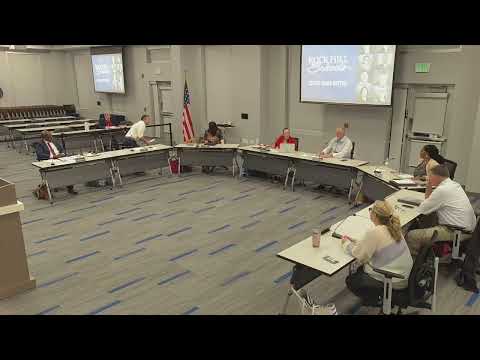
Rock Hill High School administrators presented a continuous improvement plan on Dec. 10 that pairs classroom changes with district monitoring tools as the school approaches spring end‑of‑course (EOC) tests.
An administrator summarized recent gains: academic achievement rose from below average to average, graduation rate improved by 2.6 percentage points, and college‑and‑career readiness increased by 11.2 percentage points in the cohort the school reviewed. The presentation singled out two at‑risk subgroups — students with disabilities and multilingual learners — as priorities for the next phase of work.
The plan centers on two immediate classroom strategies: standard operating procedures (SOPs) to set consistent norms and small‑group instruction to accelerate Tier‑1 learning. Administrators described district‑designed formative assessments (weeks 4, 8 and 12), district benchmarks and a 20‑day EOC prep cycle (to begin in mid‑April) for tested courses: Algebra I, English II, Biology and U.S. History. Software tools mentioned include Formative (English II), Math Nation (Algebra I) and Progress Learning (Biology); teachers are also using MasteryConnect and Membean for vocabulary work.
School leaders said administrative teams have completed more than 180 classroom observations this semester and that PLCs meet weekly with additional monthly RTI meetings. For MTSS, the school has implemented an early warning system tied to PowerSchool data, weekly MTSS committee reviews and individual action plans with follow‑up; administrators said they are expanding teams to increase capacity for check‑ins.
Board members asked whether improvements would show immediately on upcoming EOC scores; administrators said some gains are expected but full report‑card changes depend on pending assessments and retests. Administrators also emphasized challenges tied to a transient student population and urged continued partnership across district feeders to get students aligned earlier in the K‑12 sequence.
The board did not take formal action on the plan but requested ongoing updates and additional data as tests are completed.