
Planning commission recommends Taylor conditional use to commissioners, asks applicants to resolve water‑district dispute
Get AI-powered insights, summaries, and transcripts
Subscribe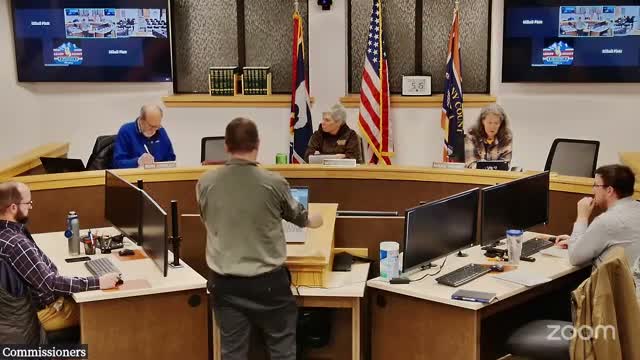
Summary
Albany County Planning & Zoning voted to recommend approval of the Taylor Conditional Use (CU‑01‑24) for a residence at 2768 Highway 130 in Centennial, conditioned on the applicants satisfactorily resolving a dispute with the Centennial Water and Sewer District.
The Albany County Planning & Zoning Commission voted to recommend that the Board of County Commissioners approve the Taylor Conditional Use application (CU‑01‑24) for property at 2768 Highway 130 in Centennial, but the recommendation is conditioned on the applicants resolving an outstanding dispute with the Centennial Water and Sewer District.
Commissioners reviewed staff analysis, questioned the planning office and the applicants about site history, right‑of‑way vacations and whether previous residential uses on the parcel were legally continuous. Planning staff recommended approval, saying the proposed residence meets the county’s findings for a conditional use in a commercial zone so long as required conditions are satisfied.
The issue that dominated deliberations was utilities: commissioners asked whether a water and sewer provider’s rules or objections could legally block county approval. Legal counsel advised the panel that the county’s approval criteria tie the decision to whether adequate public services are available “without creating an undue financial burden on the county,” and that the commission’s conditions must be linked to those findings.
During the hearing the applicants said the dwelling had already been constructed and that they did not realize a county land‑use permit was required. “I didn't think I needed a permit — it was already built,” one applicant told the commission.
After public testimony closed, a commissioner moved to recommend approval "adopting and incorporating the staff analysis, findings of fact, and conclusions of law" and expressly conditioned the recommendation on the applicants satisfactorily resolving the dispute with the Centennial Water District. The motion was seconded and carried; commissioners recorded affirmative votes and agreed the commission would forward the recommendation to the Board of County Commissioners for final action.
The commission also noted that approving an after‑the‑fact permit could set precedents for future unpermitted construction, but legal staff and planning staff emphasized that the county’s enforcement remedies and the applicant’s opportunity to legalize a use are distinct and that the commission’s role is to determine whether the application meets the listed findings. The commission left the precise threshold for what constitutes a satisfactory resolution of the utility dispute to staff, which the motion directed to define.
The matter will appear next at the Board of County Commissioners; Planning & Zoning’s recommendation and the condition tied to the utility dispute will be included in the record.