Get Full Government Meeting Transcripts, Videos, & Alerts Forever!
Get email alerts on the Education Curriculum Media topic
No spam. Unsubscribe anytime.
Beaufort advisory committee praises science in health textbook but flags dated videos
Summary
The Beaufort County Health Advisory Committee found the Glencoe Health textbook broadly appropriate for high‑school use but identified several instructional videos as dated or UK‑sourced and recommended updating media links, annotating inaccuracies, and preparing teacher and parent notifications.
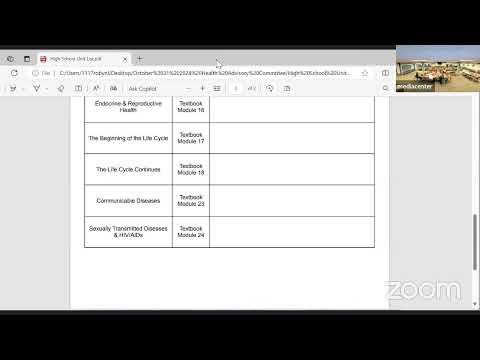
The Beaufort County Health Advisory Committee reviewed high school health curriculum materials and concluded the core textbook and supplement provide comprehensive, science‑based coverage, while flagging several videos as dated and potentially distracting for students.
"The text is very comprehensive, very appropriate, and I believe necessary for high school students in 2024," said Dr. Pierce, who led reviews of sexually transmitted infection and communicable‑disease modules. At the same time, reviewers repeatedly raised concerns that video clips embedded in multiple modules use British narration or outdated examples that could undermine student engagement.
Elizabeth Hay and other members asked whether the videos originate with a U.K. publisher or simply use U.K. voice talent. Committee members identified McGraw Hill as the publisher for the materials under review and said their objection was not the accent but the dated context and factual gaps in some clips.
Dr. Pierce pointed to a meningitis video that did not reflect newer vaccine options and said the clip appears to predate recent developments. He noted that some materials reference vaccine technologies now described as 'pentavalent' that cover multiple meningitis strains, a detail that the video does not include.
Committee reviewers recommended three steps: (1) identify and replace or annotate videos that are demonstrably out of date; (2) ask the publisher for updated media links or provide committee‑vetted alternative videos; and (3) prepare a short guidance package for classroom teachers explaining which supplemental videos are approved and how to present historical footage with context so students are not misled.
"When the video is old, students can be disengaged because it's not contemporary," one committee member said, urging substitutes that students find relatable. Several reviewers suggested that updated media could be brought back to the committee as supplements rather than automatically adopted.
The committee did not take a formal vote during the session but agreed to compile detailed notes on each module and to present recommendations to the board or at a work session. Staff identified potential presentation windows in December or at a subsequent January meeting for a formal recommendation.
Next steps: committee staff will assemble a consolidated list of flagged videos and suggested replacements, circulate that list to members for review, and prepare a recommendation for the board timetable discussed during the meeting.