Get Full Government Meeting Transcripts, Videos, & Alerts Forever!
Get email alerts on the Ag District Resolution topic
No spam. Unsubscribe anytime.
Putnam County committee reopens review of agricultural-district rules after farmer testimony
Summary
A Putnam County committee discussion of Resolution 139 of 2007 prompted extended farmer testimony about town enforcement and the county's 50% soil rule; staff said the soil threshold derives from state law (Section 305) and recommended more local review, NRCS surveys and Farm Board involvement before any county amendment.
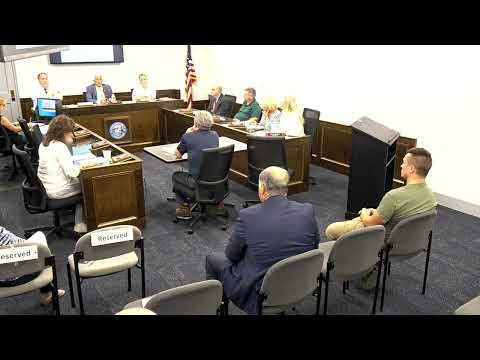
A Putnam County Physical Services Committee meeting on an agricultural-district resolution drew extended public testimony and detailed staff discussion about state-mandated soil thresholds and the county's ability to amend its rules. Committee members said they will continue the discussion after soliciting input from the Farm Board and state officials.
The committee introduced agenda item 4, a review of county Resolution 139 of 2007 that implements state agricultural-district policy. Legislative counsel and staff explained that state law uses a "predominantly" standard that county practice has translated into a 50% soil-group threshold; changing that threshold at the county level can risk inconsistency with state requirements. "A lot of the assumption is that a lot of the review process has already been done before it gets to the county," legislative counsel said, adding the county can build additional local review earlier in the process.
Farmer testimony framed the stakes. George Falcadini, speaking on behalf of Mitchell-owned farms, urged the county to amend its resolution so soil-test results would not be an automatic disqualifier. Dr. Dan Hanovich of Bridal Branch (who introduced himself as the operator of Ridge Ranch) described repeated town enforcement actions he said occurred after he sought guidance. Hanovich told the committee that USDA staff had suggested selling the property and said the difficulties ' including a shipping-container violation, site-plan costs and contested forestry and bat-protection questions ' threatened the farm's viability. "I had no idea that the heart of farming was going to be the legislative part of it," Hanovich said. He described livestock and production on his 114-acre property and said he had not applied for a tax exemption; his goal, he said, was to keep the land in farming rather than selling it for development.
Committee members and staff discussed several possible approaches: inviting the state's Ag & Markets representative or counsel to attend, commissioning an updated farmland-protection review (the current county document dates from 2004), allowing applicants to submit NRCS soil surveys or lot-line adjustments for the best soils, and clarifying public-notice practices (one legislator suggested notifying property owners within 500 feet of a proposed change). Staff cautioned that some procedural elements ' for example, a full environmental review (type 1 action under SEQR/SEQ-like processes) or measures related to wetlands and stormwater ' may still be required and could be costly.
Legislative counsel said the next specific steps are to gather more input: the Farm Board has a meeting scheduled and staff suggested inviting Ag & Markets or the county Commissioner to a future session. The committee agreed to continue the conversation and said it would collect stakeholder input before any formal amendment.
The committee did not adopt any change to Resolution 139 at the meeting; members directed staff to develop options and bring the matter back for further discussion.