Get Full Government Meeting Transcripts, Videos, & Alerts Forever!
Get email alerts on the Solid Waste Management topic
No spam. Unsubscribe anytime.
County consultant presents solid-waste management plan; says system covers operating costs but DEC may demand more
Summary
Barton & Loguidice presented Montgomery County’s draft solid-waste management plan required under NYSDEC Part 360: the plan relies on public–private transfer stations and revenue from tipping fees (reported at about $6.2 million), notes recycling-market volatility and long haul distances to disposal, and flags the likelihood that the state may require additional measures.
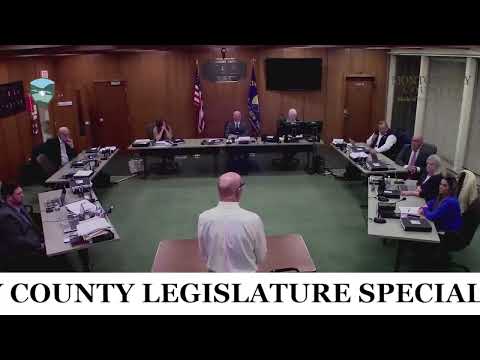
Hans Arnold, senior project manager at Barton & Loguidice, told the Montgomery County Legislature on Nov. 26 that the county’s draft solid-waste management plan (the first since the county’s departure from the regional authority) documents the current public–private transfer-station model, single-stream recycling, household hazardous-waste collections and existing local organics infrastructure. Arnold said the county currently covers system operating costs from tipping and disposal fees (presented to the legislature as approximately $6,200,000 annually) and that recyclables markets are volatile and global, not locally controlled.
Arnold and Alyssa Dunlowski, an engineer on the project, outlined key vulnerabilities: long transport distances to the disposal site used (Seneca Meadows, roughly 200 miles), limited landfill options in New York, and recycling markets that have shifted since China restricted imports in 2017–18. The plan includes a 10-year composition analysis, market assessments and technology evaluations (waste-to-energy, pyrolysis, anaerobic digestion), but Arnold said most alternatives are significantly more expensive than current landfilling and therefore not feasible at this time.
Arnold said the draft must be posted for public review and that the county must submit it to the New York State Department of Environmental Conservation (DEC) under Part 360. He predicted DEC may request additional actions and indicated the consulting team would defend the plan but be prepared to return to the legislature if the state requires more measures.
The presentation emphasized maintaining convenient single-stream recycling and investing in public education (schools and outreach) as lower-cost, high-impact measures. Arnold also noted the county’s relative success in competitive bidding for disposal and recycling contracts compared with other jurisdictions.
What happens next: The draft plan will be posted for public review per DEC requirements; DEC review and requested modifications are expected, and county staff and the consultant will respond as needed.