Get Full Government Meeting Transcripts, Videos, & Alerts Forever!
Get email alerts on the Municipal Budget topic
No spam. Unsubscribe anytime.
Simsbury tri‑board outlines $3 million budget gap; finance board proposes phased use of reserves and other levers
Summary
At a joint meeting in Simsbury Center, board leaders described a roughly $3.0 million shortfall driven by a state cap on motor‑vehicle revenue and rising fixed costs, proposed using $2.3 million in capital reserves in year one to lower the immediate tax impact, and flagged a potential Board of Education real‑estate purchase to be financed with reserves or bonding.
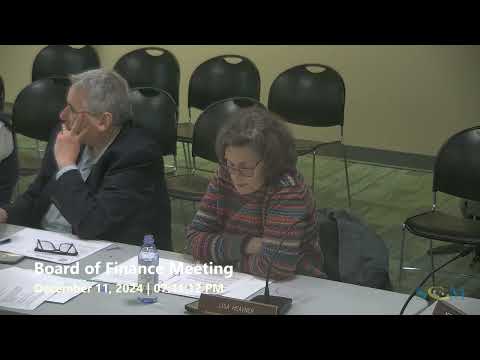
Lisa Hebner, speaking for the Board of Finance, told the joint meeting that the town faces a difficult budget year driven by lower revenues and rising fixed costs. "We've had 2 years of higher than normal tax increases, 4.7% last year and 5.2% this year," she said, and warned that a new state limit on motor‑vehicle valuation would reduce the grand list and revenue. Based on preliminary estimates, she said, fixed costs are expected to rise by about $5.6 million and, without offsets, the tax increase could approach 6.94%.
The finance board proposed a mix of tools to narrow that gap, including a staged use of capital reserves: "We will use that $2,300,000 over the next 3 years to lower tax increases," Hebner said, describing a plan that applies $1.3 million in year one, $700,000 in year two and $300,000 in year three. She emphasized the board's intent to avoid creating a fiscal "cliff" for future budgets and to protect the town's AAA bond rating.
Officials listed other levers under consideration: tapping health reserves (contingent on consultant recommendations), pursuing targeted operating reductions, evaluating reduced annual bonding levels, and pursuing grants or fees where feasible. Staff cautioned that some favorable one‑time items that bolstered reserves last year — notably higher interest income and a municipal revenue‑sharing grant — are not expected to recur. The presenter summarized the arithmetic this way: "We've got to find $3,000,000 in cuts, $3,000,000 in savings, or $3,000,000 in new revenue."
Board of Education representatives described a phased school program and recent capital decisions. Education staff said the district moved about $3.2 million of capital projects out of the first‑year plan (including a roof project) and is exploring a fee/tution‑supported program model for some out‑placed students to reduce operating pressure. Town staff and the board of education also reported ongoing negotiations for a potential school‑related real‑estate purchase; the town attorney and final numbers must be completed before any contract is presented, and the finance board signaled a preference for funding with cash reserves but left bonding on the table depending on final costs.
Members pressed staff for timing and quantification on uncertain items that could materially change the outcome: updated grand‑list figures are expected in January/February, a consultant report on health‑plan savings is due in January, and an OPEB valuation is pending. Staff described multiple scenarios showing that combinations of health savings, vacancy‑driven salary savings, and modest budget reductions could materially lower the tax impact; conversely, absent those offsets the boards would need to plan for sizable cuts or additional use of reserves.
On several narrower items, the boards tabled a parks‑and‑recreation supplemental appropriation for storm cleanup pending invoices and year‑end projections, and approved the minutes of a November 12 special meeting by voice vote (tally not recorded in the transcript). The tri‑board adjourned and the Board of Finance continued into detailed scenario work and debt‑service projections.
Next steps: boards will revisit guidance in January after receiving updated grand‑list numbers, health‑plan recommendations, and other finalized estimates; staff will prepare scenario worksheets for $1M–$3M in adjustments so the selectmen and board of education can evaluate options.