Get Full Government Meeting Transcripts, Videos, & Alerts Forever!
Get email alerts on the Housing Policy topic
No spam. Unsubscribe anytime.
Simsbury zoning commission continues hearing on housing toolkit after broad public concern
Summary
The Simsbury Zoning Commission heard a presentation on ZC2406 — a package of four housing strategies including ADU rule changes, a new R‑8 small‑lot zone, an inclusionary set‑aside and revisions to the workforce housing overlay — and, after extensive public comment, voted to continue the public hearing to Jan. 22.
Town Planner George McGregor presented the Simsbury Zoning Commission with a four‑part “housing strategies toolkit” (ZC2406) at the commission’s Dec. 16 meeting, outlining proposed changes to accessory dwelling unit (ADU) rules, an inclusionary zoning option, a new standard R‑8 small‑lot zone and revisions to the town’s workforce housing overlay. After more than a dozen members of the public spoke, the commission voted to continue the public hearing to Jan. 22, 2025.
McGregor told commissioners the toolkit is intended to implement objectives in the town’s Plan of Conservation and Development (POCD), recently adopted in 2024, and to expand housing choices while maintaining Simsbury’s character. He described four core elements: allowing ADUs as a by‑right matter if they meet zoning standards and measuring ADUs by “gross building area” rather than “gross floor area”; a draft inclusionary set‑aside that would require 15% of units in any project over 10 units to be affordable (half at 60% of area median income, half at 80% AMI) with a 4‑year deed restriction as drafted and no fee‑in‑lieu language; a new R‑8 standard zone with a minimum lot size of 8,000 square feet permitting single‑ and two‑family homes as‑of‑right; and revisions to the workforce housing overlay (including a proposed name change and removal of a hard 750‑foot locational restriction and an inflexible 20% requirement). McGregor also outlined potential developer incentives such as parking reductions and density bonuses and noted the commission cannot offer tax abatements within its zoning regulations.
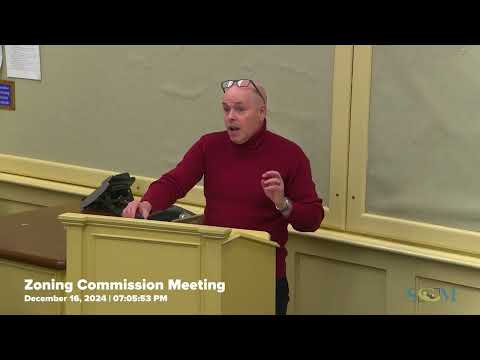
Public commenters raised procedural and policy objections. Mary Turner, saying she has lived in Simsbury 50 years, asked why four distinct proposals were bundled together and argued that loosening ADU rules (including separate utilities and unrelated occupants) would remove safeguards: “Each different proposal should appear in its own setting and separately considered on its merits by the zoning commission.” Joan (Whitcomb Drive) said prior local affordable‑housing efforts had not served very low‑income families and warned that deed restrictions and resale requirements had been reversed in the past; she urged the commission to reject ZC2406 as drafted. Chris Barnett said he supports affordable and diverse housing options but called for more public hearings outside the holiday season and said the inclusionary requirement should focus on multifamily projects rather than single‑family homes. Other residents asked for maps showing where R‑8 or overlay zoning might be applied, projections of unit counts over a 10‑year horizon, and analysis of impacts on services such as water and roads.
Commissioners and staff clarified process questions: adopting an R‑8 designation would itself require a formal rezoning application, adjacent‑owner notice and a separate public hearing, and a property could not be rezoned to R‑8 without that process. Staff said ADU approvals have averaged about two per year historically. Several commissioners expressed that more public input was warranted after the holidays; a motion to continue the public hearing to the commission’s regular meeting on Jan. 22 was made, seconded and passed by voice vote with the chair announcing the motion passed, 6‑0.
Next steps: the public hearing on ZC2406 will continue on Jan. 22, 2025, allowing further public comment and for the commission to request additional staff materials (maps, projected unit‑count scenarios and related analyses) before substantive votes on any text amendments.
Quotes used in this story come from meeting remarks and public comments recorded on Dec. 16, 2024.