Get Full Government Meeting Transcripts, Videos, & Alerts Forever!
Get email alerts on the Stream Dredging topic
No spam. Unsubscribe anytime.
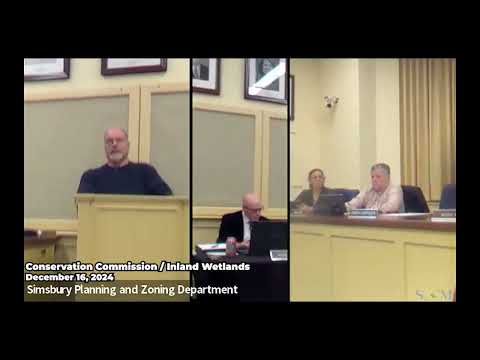
Commission approves Pop Meadow Country Club stream dredging and drainage with seed and cotton-matting conditions
Summary
The Simsbury Conservation Commission approved application CC-2437, allowing Pop Meadow Country Club to dredge a stagnant stream and install drainage at 85 Firetown Road, adding conditions requiring conservation seed mix and biodegradable cotton matting and requiring erosion controls and revegetation.
The Simsbury Conservation Commission approved a wetlands permit for Pop Meadow Country Club to dredge accumulated sediment and install drainage at 85 Firetown Road, adding conditions that the applicant use a conservation seed mix and biodegradable cotton matting for erosion control. The motion to approve application CC-2437 passed by voice vote.
Rod Fleming, the club’s general manager, introduced Mark, the club’s new superintendent, who explained the work would dig out and remove organic material from a narrow, largely stagnant stream to restore drainage. The presenters described methods including an excavator straddling the stream, hauling material to a designated dump site, installing two grama (grass) lines to route drainage, straw wattles and localized netting in erosion-prone areas, and reseeding with native vegetation or a conservation seed mix.
During public comment, Steve Root, a Maple Corner resident, asked whether dredging could cause downstream impacts. The presenter replied that the stretch is mostly stagnant and that ‘‘there shouldn’t be any downstream effects’’; staff and the applicant said they would secure potential movement with riprap and containment and that the goal is to restore flow rather than increase downstream discharge.
The commission approved the permit with the standard findings that short-term impacts can be controlled by erosion- and sediment-control measures; commissioners explicitly added a requirement for cotton matting and a conservation seed mix and required compliance with staff conditions.
Next steps: the applicant will implement the erosion-control and revegetation measures and coordinate with staff on timing; staff will inspect stabilization and enforce permit conditions.