Get Full Government Meeting Transcripts, Videos, & Alerts Forever!
Get email alerts on the Flooding And Drainage topic
No spam. Unsubscribe anytime.
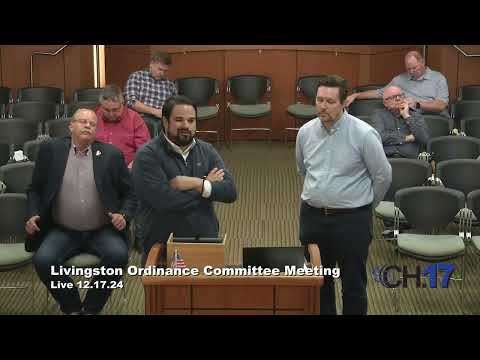
Livingston Parish committee reviews flood and drainage code changes aimed at FEMA CRS savings
Summary
Committee heard presentations on proposed amendments to chapter 115 (floods) and chapter 125 (subdivision regulations) to adopt a drainage criteria manual, add a 5‑year storm calculation, raise finished‑floor freeboard from 1 to 2 feet, require compensatory storage/no‑net‑fill and seek CRS credits that could lower residents' flood insurance premiums.
Livingston Parish ordinance committee heard detailed presentations about proposed changes to subdivision and floodplain rules intended to reduce flood risk and earn points in FEMA’s Community Rating System, which consultants say could lower residents’ flood‑insurance premiums.
Consultants from HALF and JPF Planning explained that the package would pull technical engineering specifications out of ordinance text and place them into a separate Livingston Parish drainage criteria manual, update rainfall data and require new engineering checks — including a 5‑year storm calculation — so that smaller, more frequent flood events and erosion risk are evaluated. Jack Young of HALF said the manual is “the how” while the ordinance remains “the what,” making technical updates easier for engineers to reference and for the parish to update later.
The revisions to chapter 115, which govern development in floodplains, would raise the minimum finished‑floor freeboard from one foot above the 100‑year base flood elevation to two feet, and set material and compaction standards for fill used in floodplain construction. The plan also includes a compensatory storage requirement — described as a “no net fill” policy — so that any fill placed below the base flood elevation must be offset by an equivalent cut or storage on the same parcel or immediately adjacent area. Young said the changes are not arbitrary; they are intended to earn CRS credits and “significantly more” mitigation points.
Gary O’Neil, a longtime parish resident who submitted printed CRS projections, told the committee the changes could translate into meaningful savings for homeowners. “This is literally making their homes cheaper to own,” O’Neil said, displaying a printout of estimated parish‑wide premium reductions tied to achieving a higher CRS class.
Consultants highlighted technical safeguards: clear guidance on acceptable fill material (good soil, rock, broken concrete, compacted and engineered), a modeling requirement to show projects will not increase base flood elevation, and as‑built surveys plus, where applicable, submission of Letter of Map Revision or Amendment (LOMR/LOMA) to FEMA to update flood maps. Jerome Fournier of JPF Planning emphasized the ordinance changes largely address administration and definitions FEMA flagged as noncompliant and that adopting current vertical datum (e.g., NAVD88/Geoid 18) should be used in the ordinance language.
Council members and public commenters pressed for precision on several points: which rainfall dataset will be adopted, how often the data will be refreshed, how compensatory storage is measured and enforced, and the role of an appeal or adjustment board. Consultants said rainfall data references will be updated to the most current available dataset and that the parish typically requires grading and as‑built documentation; enforcement frequently relies on submitted engineering plans, inspections and recorded survey evidence. The presentation clarified that the 5‑year event is being added to reduce erosion and protect channels from repeated smaller events, while the 100‑year standard remains the controlling design flood for base elevations.
No ordinance vote occurred at the committee meeting. Consultants and staff offered to return to answer technical follow‑ups and to provide clarifying language on vertical datum and appeal mechanisms before the ordinance is advanced to the full council or public hearing stage.