Get Full Government Meeting Transcripts, Videos, & Alerts Forever!
Get email alerts on the County Budget topic
No spam. Unsubscribe anytime.
Eaton County commissioners outline options for incoming board after millage defeat
Summary
At a Ways & Means advisory workshop, commissioners reviewed options to close projected budget gaps following a failed millage, including hiring freezes, targeted position reviews, renegotiation of the Delta Township sheriff contract, and lobbying the state on unfunded mandates.
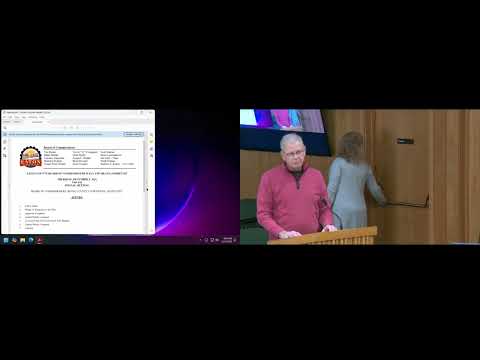
Commissioners and county staff on Monday described a range of steps the incoming Eaton County board should consider to address a possible structural budget gap after voters rejected a millage.
At an advisory Ways & Means workshop that the chair said would include no formal actions, commissioners and staff discussed personnel reductions, contract negotiations, capital spending and the risks of cutting grant-matched positions. The chair framed the session as a nonbinding effort to give the next board options and said the current adopted budget runs through next fall with only a small fund-balance carryover.
The discussion centered on where to find sustainable reductions without undermining mandated services. Controller-level staff advised that any cut recommendations be expressed as dollar amounts rather than flat percentages—because a percentage reduction affects the sheriff, prosecutor and courts differently than smaller offices such as the clerk or treasurer. Staff gave a preliminary overtime number for sheriff road patrol shift changes: about $160,000 in overtime impact for the affected shift last year; department-level net savings and percent impacts were not finalized and staff said they would follow up.
Commissioners repeatedly flagged grant-funded roles as a vulnerability: eliminating local matching dollars for programs such as veteran services or specialty courts could also eliminate the accompanying state or federal grant positions. One commissioner noted that temporarily using leftover COVID funds to backfill employee benefits last year roughly equated to 6–7 positions and warned those funds are not permanent.
Public safety dominated much of the exchange. Commissioners said the Delta Township sheriff contract—one of the county's largest public-safety expenditures and due for renewal at the end of the fiscal cycle—must be reviewed by the incoming board. Several commissioners urged negotiating formulas and line-item reimbursement rather than immediately cutting services; others warned against singling out Delta Township, which multiple speakers said provides a large share of the county tax base.
Other options discussed included revisiting outside-agency allocations (Board of Health, Community Mental Health, MSU Extension), reassessing capital plans and leases, selling or repurposing underused facilities, and limited bonding for necessary infrastructure while noting bond ratings and long-term debt service would increase costs. Commissioners also recommended a position-by-position assessment to determine which roles are mandated, which are partially mandated and which are discretionary.
Staff and commissioners discussed service delivery changes such as reduced in-person hours and broader use of remote work for positions where feasible, balancing potential savings against service access and IT costs. Eric Daly (technology staff referenced in the meeting) and other staff are reviewing laptops, desktops and remote-work costs to inform such decisions.
Court operations drew attention: Amy Etzel, court administrator, said several court positions remain vacant (she cited five Friend of the Court openings) and asked the board to allow targeted fills for critical roles because vacancies were hampering court operations.
Several commissioners urged the incoming board to work with regional partners and Michigan advocacy groups to press the state for relief from unfunded mandates and for more stable revenue-sharing; one commissioner estimated millions of dollars in annual cost pressure tied to mandates and pension funding timelines.
The workshop ended with advice for newly elected commissioners to pursue intensive orientation and data-driven workshops so the next board can act quickly. Staff committed to provide the precise overtime and fund-balance figures requested during the meeting. The session included public comment from residents who urged clear accounting of township reimbursements and cautioned against divisive rhetoric.
The Ways & Means committee did not take any votes at the workshop; staff said they would compile requested numbers for the next meeting.