Get Full Government Meeting Transcripts, Videos, & Alerts Forever!
Get email alerts on the Development Costs topic
No spam. Unsubscribe anytime.
Irving consultants outline tools to reduce housing development costs, urge targeted incentives
Summary
Consultants leading a City of Irving public session said accurate market analysis, faster entitlement, and targeted use of city-owned land and incentives — including Neighborhood Empowerment Zones and community land trusts — are key to lowering development costs and expanding affordable housing.
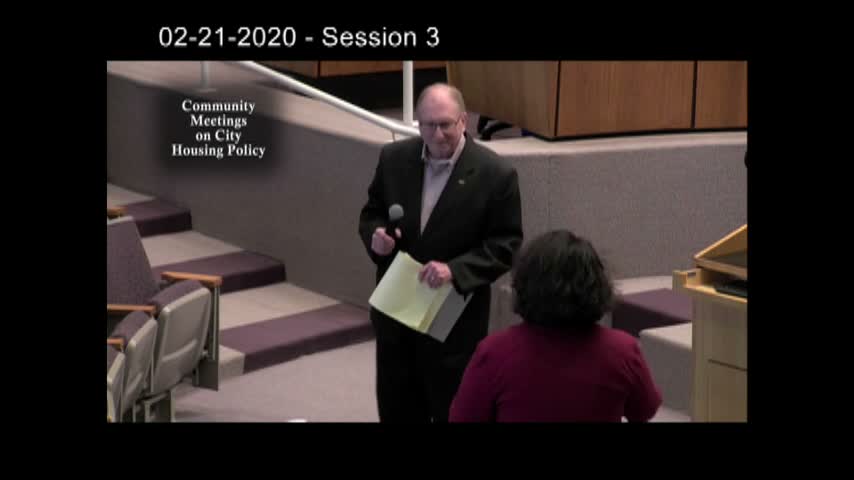
Irving officials and consultants reviewed strategies for lowering the cost of producing housing at a public input meeting attended by residents and local developers.
"A housing problem can really be described as basically two economic problems," said Raquel Favela of the National Development Council, summarizing the day: affordability (a gap between what households can pay and market prices) and disinvestment (areas where costs to build cannot be supported by rents or sales). Favela urged the city to combine national examples with local feedback to choose tools that fit Irving's market.
Favela and other presenters said five core pieces must be in place for viable development: accurate construction-cost estimates; clear market and demand analysis; reliable appraisal inputs for lenders; budgeting for sales and leasing; and active management of production and financing timelines. They stressed that delays in entitlement and permitting raise carrying costs and reduce developer returns, sometimes more than direct financial incentives.
To address land and acquisition costs, the consultants suggested several approaches: identify city-owned parcels suitable for mixed-income projects, consider repurposing public buildings, and use mixed-income developments near higher-value markets rather than concentrating affordable units. "Start from the strength rather than fighting the market conditions," Favela said, noting the city can recommend that some projects set aside a share of units for affordable households.
The presentation reviewed program tools available in Texas. Neighborhood Empowerment Zones can be used to freeze property value for tax purposes for up to 10 years and enable fee waivers for qualifying projects, while cities can provide resolutions of support for Low-Income Housing Tax Credit applications (LIHTC) administered by the Texas Department of Housing and Community Affairs. Favela noted federal programs such as HOME and HUD-set caps often limit per-unit subsidy and that local general funds or bond proceeds must top up assistance when greater subsidy is needed.
Speakers discussed construction innovations but cautioned that modular or container-based construction does not automatically lower costs due to foundations, on-site work, transport permits and overnight labor costs. Developers in the room repeatedly identified land acquisition as the single largest cost driver in Irving.
City staff said other policy options include incentive zoning (density bonuses), accessory dwelling units where appropriate, and targeted programs to help homeowners in more stressed markets make repairs and remain in place. Consultants recommended exploring community land trusts and, where legally possible, a land bank to help the city secure parcels for long-term affordable housing.
The city asked residents to submit additional suggestions by email and announced follow-up meetings on March 3 on capital access and strategies to increase production. No formal votes or binding commitments were made at the session.
The next procedural step: staff will compile feedback and return with potential program details at future sessions.