Get Full Government Meeting Transcripts, Videos, & Alerts Forever!
Get email alerts on the Project Finance topic
No spam. Unsubscribe anytime.
Consultants show financing math: a 140‑unit example highlights a multi‑million dollar subsidy gap
Summary
A consultant used a 140‑unit illustration to show how income‑restricted rents reduce net operating income and lender borrowing capacity, producing a gap the city or other public sources would need to fill to make deeply affordable projects feasible.
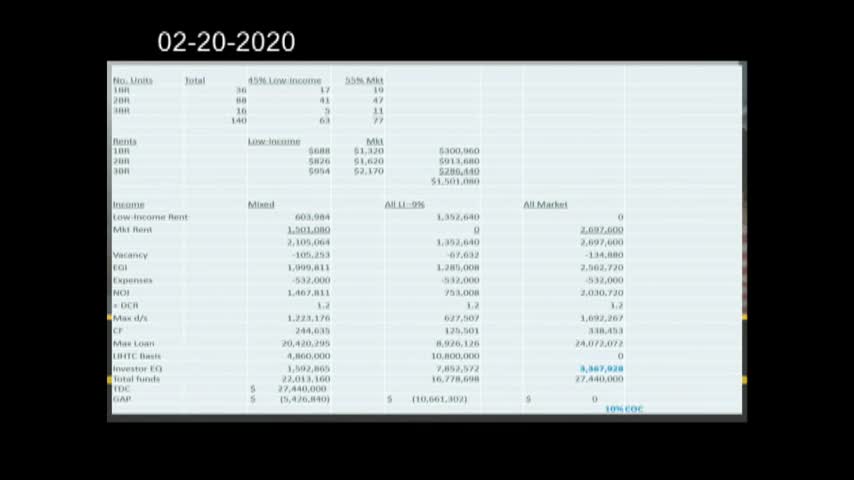
At a City of Irving community meeting, Raquel Favela (National Development Council) presented a 140‑unit project illustration to show how different rent mixes change developer returns and public subsidy needs.
Favela gave the project’s estimated total cost as $27,400,000. Under an all‑market scenario she said the project’s effective net operating income (NOI) would be roughly $2,030,720 and could support borrowing in the range of about $24,000,000. In a fully income‑restricted scenario she reported an NOI around $753,000, which would lower borrowing capacity to about $8,900,000; she estimated tax‑credit equity at about $7,800,000 and calculated a remaining public subsidy gap of roughly $10.66 million that would have to be filled by city or other public funds to make the all‑income‑restricted option feasible.
"So the difference here between the 27.4 and what they can borrow and what they raise in the tax credit equity is what the city or other public sources of funds would need to fill," Favela said, noting that mixed‑income blends (for example, 55% market / 45% income‑restricted in her example) substantially reduce the per‑unit subsidy the public would need to provide.
She used the illustration to explain why purely market deals, purely income‑restricted deals and mixed‑income deals each have tradeoffs: all‑market projects raise more private capital but produce fewer subsidized units; all‑income‑restricted projects offer deeper affordability but require much larger public subsidies; mixed‑income structures can strike a balance by leveraging private debt, tax‑credit equity and a smaller public gap.
Favela and staff encouraged residents to comment on the relative support for mixed‑income, 100% affordable or 100% market approaches through note cards or the planning email address.