Get Full Government Meeting Transcripts, Videos, & Alerts Forever!
Get email alerts on the Bird Friendly Design topic
No spam. Unsubscribe anytime.
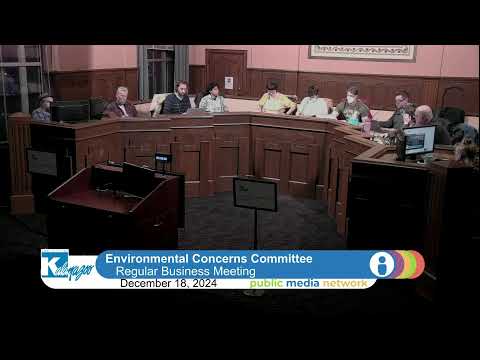
Kalamazoo ECC votes to forward bird-friendly building design recommendation to City Commission with amendment
Summary
The Environmental Concerns Committee voted to send a bird-friendly building design ordinance to the City Commission and/or staff for feasibility study, adding a friendly amendment requiring 25% of a structure's glass to be bird-safe within five years for major renovations or new construction.
The Kalamazoo City Environmental Concerns Committee voted to forward a proposed bird-friendly building design ordinance to the City Commission and requested staff study the feasibility of implementation. The motion, moved and seconded during unfinished business, passed with no recorded opposition.
Gail, presenting material adapted from American Bird Conservancy guidance, recommended focusing the ordinance on new construction and major renovations rather than retrofitting typical residences, because commercially available bird-safe glazing is more accessible for commercial projects. She said the incremental cost of bird-safe glass on commercial construction has been estimated at roughly 0.4% in example calculations and that the glass component is a small portion of total window-and-frame costs.
Members raised implementation questions: whether residential replacements should be included, how smaller homeowners access materials, and whether developers could split replacement work over time to evade replacement thresholds. Tresa Graschak proposed, and the maker of the motion accepted, a friendly amendment specifying that replacement timing would require 25% of a structure's transparent/reflective material to be bird-safe within five years to prevent phased avoidance of the requirement.
Committee members noted the ordinance had already been shared with the city building official and planning staff and that the ECC’s role is to propose strong environmental recommendations for the City Commission and staff to consider. The committee approved moving the recommendation forward to the city (vote recorded as passing by those present). Gail offered to assist further with technical advice if requested.
Next steps: staff will investigate feasibility and implementation details for City Commission consideration; the ECC’s recommendation will advance the issue to city officials for formal drafting and public review.