Get Full Government Meeting Transcripts, Videos, & Alerts Forever!
Get email alerts on the Urban Deer Management topic
No spam. Unsubscribe anytime.
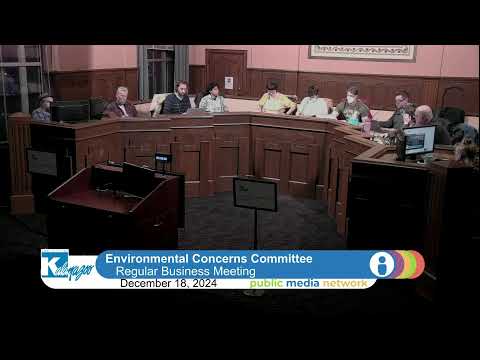
DNR tells Kalamazoo committee deer are abundant; city may seek 2026 funding for population survey
Summary
The Kalamazoo City Environmental Concerns Committee heard a Michigan DNR briefing on urban deer biology, collision hotspots and management options; the committee discussed nonlethal tools, hunting/sharpshooting constraints, and a planned 2025 budget request to fund a 2026 city deer survey.
Don Poppy of the Michigan Department of Natural Resources told the Kalamazoo City Environmental Concerns Committee that white-tailed deer are an abundant species statewide and not yet subject to chronic wasting disease in Kalamazoo County. Poppy described disease risks, recent pockets of epizootic hemorrhagic disease and a statewide peak in deer-vehicle collisions last seen in the early 2000s.
The committee heard that city staff reviewed 3-1-1 calls about deer in 2024 and recorded 63 total calls, including 35 reports of dead deer in the right of way and 17 reports of dead deer on private property. Justin Sanders said the city will request budget funding in 2025 to pay for a population survey if the request is included in the 2026 budget.
Poppy described management options and trade-offs: doing nothing; exclusion tools such as fencing and vegetation management; nonlethal hazing and repellents; contraception and sterilization (which do not remove animals from the population and are rarely permitted outside research); trapping and translocation (stressful and discouraged); hunting or sharpshooting (lethal options that require landowner authority and are often expensive to implement). He noted that municipal ordinances against discharging projectiles (firearms and often archery equipment) commonly limit hunting in cities and that any lethal control also requires a safe location and appropriate permits.
Committee members raised ecological concerns that heavy browsing can degrade native understory plants and reduce habitat suitability for other species. Members also discussed collision patterns: heat-map data presented to the committee showed clusters along US-131 and I-94, which some attendees suggested may involve animals from outside the city’s core home ranges.
Poppy recommended continued monitoring, targeted outreach to reduce feeding and attractants, exclosures at vulnerable natural areas, and coordination with landowners (including Western Michigan University, which owns Asylum Lake Preserve). He said DNR staff can help with deer management assistance permits and programs such as Sportsmen Against Hunger, which can channel harvested venison to food assistance programs.
The committee did not take a formal policy vote on deer management but directed staff to continue analyzing 3-1-1 data and to pursue the proposed survey funding request in 2025 for potential inclusion in the 2026 budget cycle.