Get Full Government Meeting Transcripts, Videos, & Alerts Forever!
Get email alerts on the Rezoning Development topic
No spam. Unsubscribe anytime.
Commission recommends denial of Brighton’s Pollard North rezone and preliminary plat
Summary
After extensive public comment and deliberation, the Meridian Planning & Zoning Commission voted to recommend denial to City Council of Brighton’s rezone and preliminary plat for Pollard North (file H2024‑0037), which would have changed ~22 acres from R8 to TNR and increased lots from 74 to 177.
The commission voted to recommend denial of Brighton’s Pollard North rezone and preliminary plat (file H2024‑0037) after more than an hour of testimony and deliberation about density, neighborhood transition, traffic and infrastructure.
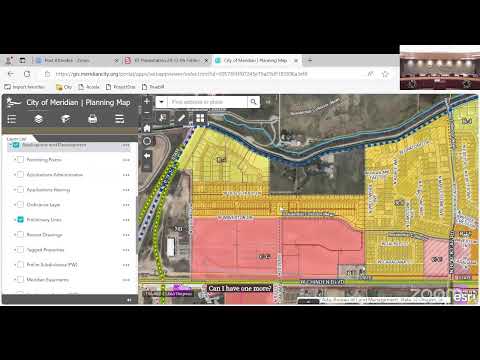
Staff described the proposal as a rezone of about 21.9 acres from R8 to Traditional Neighborhood Residential (TNR) and a preliminary plat for 177 single‑family detached and attached lots on about 19.76 acres; staff recommended approval with conditions and noted the applicant proposes 3.53 acres (about 17.86%) of qualified open space and several amenities.
Brighton representatives said market conditions led them to remove a planned assisted‑living building and replace it with more homes; John Wardle, the Brighton representative, said "the assisted living isn't viable" and emphasized the developer’s investments in Levi Lane, Waiverton and other infrastructure. The applicant argued the plan provides a transition between commercial uses to the south and larger lots to the north.
Numerous neighbors voiced opposition, citing traffic and safety for children, insufficient green space for the doubled number of residents, and inconsistency with what many said they expected when they moved to the area. Resident Kyle Ensler told the commission he "strongly disagree[d] that the proposed zoning change...creates a better transition to the neighbors to the north" and urged denial. Several residents said the proposal felt like incremental changes that would ultimately increase density beyond what neighbors anticipated.
Commissioners debated tradeoffs between housing supply and neighborhood compatibility. Some commissioners said the site and developer contributions (roads and utilities) made the application understandable; others said the increase from the previously approved plan was too large and the transition to low‑density neighborhoods insufficient. Chairperson Archer moved to recommend denial to City Council, citing excessive density and poor transition to low‑density lots; the motion carried by voice vote and the commission will forward the record and rationale to City Council for final action.