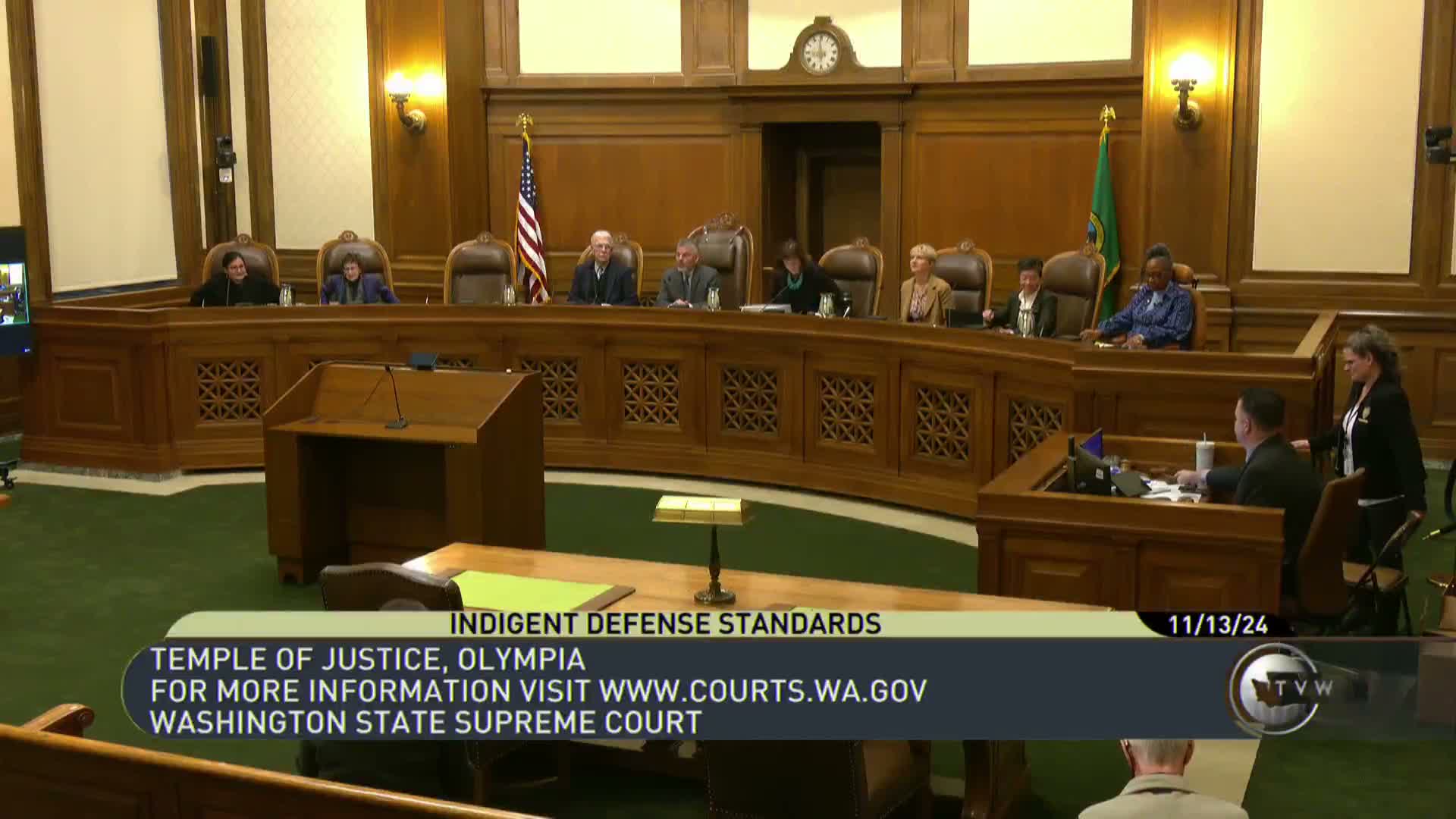
Washington Supreme Court hears wide-ranging testimony on proposed indigent-defense caseload standards
Loading...
Summary
At a Nov. 13 public hearing, defenders, prosecutors, elected officials and advocates offered sharply divided testimony on Washington State Bar Association-recommended caseload limits: defenders and civil-rights groups urged adoption to prevent long delays and protect constitutional rights, while counties and cities warned of severe fiscal and operational consequences without state funding or a Washington-specific study.
The Washington State Supreme Court convened a second public hearing on Nov. 13, 2024, to gather input on proposed statewide indigent-defense caseload and support standards recommended by the Washington State Bar Association.
Dozens of witnesses spoke for and against the rules, which would lower maximum caseloads for public defenders and require minimum non-attorney support. Supporters said the current, higher limits leave clients waiting months or years for adequate representation and that modern criminal cases demand more time because of digital evidence and complex forensic work. "Standards are not standards if they don't apply equally across the board," Jason Schwartz, a past chair of the Council on Public Defense, said, arguing the CPD's Washington-localized study—adapted from national research—provides a sufficient basis for statewide rules.
Several public defenders and civil-rights advocates framed the issue as a constitutional and racial-justice concern. "Public defenders are a critical check on that danger," King County public defender Austin Field said, urging the court to consider caseload limits as essential to ensuring investigators can review body-worn video and other evidence. Matthew Sanders, interim director of the King County Department of Public Defense, called the situation "a crisis in public defense" and asked the court to adopt the standards and order immediate implementation.
Opponents raised questions about the research and near-term costs. Deanna Dawson, CEO of the Association of Washington Cities, recommended a Washington-specific study and a task force, warning that adopting the proposal statewide could have "devastating consequences" and citing an estimated implementation cost she described as "over a $1,000,000,000" for public defenders. Several county and city officials described detailed local models. "Meeting the standards by 2025 would require Pierce County to add 28 full time staff, costing us between about $9,800,000 to $11,600,000 just in year 1," said Ryan Mello, chair of the Pierce County Council.
Local elected executives and county associations urged delay so the legislature or a broader work group could assess fiscal impacts and identify funding sources. "To meet the mandate for caseloads, we would need to shift funding away from other components of the criminal justice system," Snohomish County Executive Dave Somers told the court, and he asked the Office of Public Defense to convene a cost-modeling work group.
Several speakers proposed compromise approaches. The Superior Court Judges Association recommended adopting Phase 1 of the proposed standards but delaying Phases 2 and 3 to gather county-by-county information. The Washington State Office of Public Defense said it supports the standards and the three-year implementation timeframe in principle but proposed limited extensions (four to five years) for jurisdictions that can show transparent plans and benchmarks.
Speakers also emphasized alternatives and complementary reforms, including expanded investigator and social-worker support, diversion programs such as LEAD, and loan-repayment or pipeline initiatives to grow and retain the defender workforce. "Case weighting and other things can take into account local practices," Christie Hedman of the Washington Defender Association said, while urging legislative funding to make standards workable.
The court did not take action at the hearing; the presiding justice thanked participants and said the court will determine next steps ahead of an en banc session scheduled for Dec. 4. The hearing record will include dozens of written comments the court said it was still compiling after earlier website interruptions.