Get Full Government Meeting Transcripts, Videos, & Alerts Forever!
Get email alerts on the Bonds And Infrastructure topic
No spam. Unsubscribe anytime.
Developers object to Marlborough retainage policy after engineers outline bond estimates for multiple subdivisions
Summary
Engineering staff presented bond estimates for several subdivisions (including $264,000 for 547 Sow Road); a developer criticized the city's retainage and lot‑holding practices as excessive, and staff explained retainage aligns with construction contract practice and that bond and lot holds serve different guarantees.
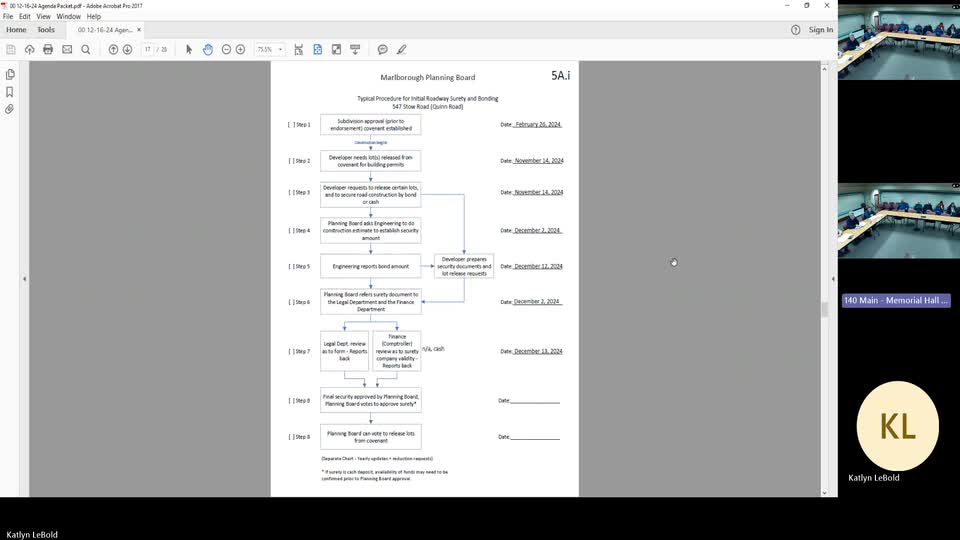
Engineering staff told the Marlborough Planning Board that the engineering division had inspected subdivisions under construction and tabulated amounts to secure remaining work.
For the 547 Sow Road subdivision, staff reported an estimated security amount of $264,000 to secure remaining improvements. At one point an attendee cited an $800,000 total road estimate for a different subdivision, saying roughly $600,000 of work was complete and about $200,000 remained; that attendee calculated a 10% retainage as about $80,000.
The attendee identified as "Fred" and others pressed staff about how bond reductions and retainage work. "So you're holding $80,000 for me to do $8,000 of work and you're holding a building lot ransom," the attendee said, arguing the retainage and the board's practice of holding a lot until acceptance can feel excessive—especially on small subdivisions where holding one lot can represent a large share of the development.
City engineering staff (Unidentified Speaker 3) responded that the retainage and the lot hold are two separate protections: the bond assures satisfactory completion of construction and utilities, and the lot hold ensures all deeds, easement rights and acceptance plans are in order so the city can accept the street. Staff said the retainage practice mirrors how the city pays for infrastructure contracts and is meant to make sure sufficient funds remain available to finish or correct work if necessary. The staff member also outlined the road‑acceptance steps: the developer notifies staff when work is finished, engineering conducts final inspections, and the board and city council are petitioned for road acceptance.
Board members said they want to reduce the backlog of unaccepted streets and noted they have a list of many subdivisions in which roads remain unaccepted. The board voted to accept and file the engineering correspondence and to authorize the chair to sign required documents on behalf of the board upon confirmation from the comptroller that proper surety has been posted.
Board members and the developer agreed to continue discussion at a future meeting in January; no change to the retainage policy or immediate reduction of bond amounts was adopted at the session.