Get Full Government Meeting Transcripts, Videos, & Alerts Forever!
Get email alerts on the Reentry Programs topic
No spam. Unsubscribe anytime.
Project Return highlights employment-first reentry model as recidivism falls
Summary
Project Return told the Senate Corrections Committee that employment-focused wraparound services, plus housing and transportation, have helped hundreds of people reentering from prison find work and reduce recidivism; a former participant testified it transformed his life.
Rico X, CEO of Project Return Incorporated, told the Senate Committee on Corrections on Oct. 9 that his Nashville-based reentry nonprofit centers on employment and wraparound supports — identification documents, transportation, child-support help, clothing and housing — and reported measurable outcomes as state recidivism declined.
"As of late, we have seen some positive results as it relates to recidivism," Rico X said, noting the state rate recently dropped to 29% and saying Project Return's internal figures are lower for its participants. Kelsey Hall, the organization's chief strategy officer, told the panel the group served 628 new enrollees this year and more than 1,500 people overall. Hall said participants who complete transitional employment and a 12-month job-retention program show recidivism rates typically around 5% or less.
The presentation emphasized three revenue streams that sustain Project Return: state appropriations and local government reimbursements, income from three social enterprises that place program participants in local employer contracts, and private foundation and individual contributions. Rico X said roughly one-third of the organization's budget comes from its earned-income enterprises, with the remainder split between government support and philanthropy.
A program graduate, Victor Dyson, addressed the committee directly about his experience. Dyson said he was paroled in July 2019 and connected to Project Return’s services, which he said provided housing, transportation and rapid access to paid work. "I have housing; I have a vehicle; I'm a proud employee of Project Return," Dyson said, describing his current role as a transportation coordinator and his role mentoring other participants.
Committee members pressed Project Return staff on enrollment numbers, program duration and funding. Hall said the agency serves participants for 12–15 months when they take full advantage of available programs and estimated that 40–50% of newly enrolled participants use transitional employment placements. On funding, the group cited three buckets: recurring TDOC appropriations and some state/local government reimbursement; revenue from social enterprises; and private grants and donations.
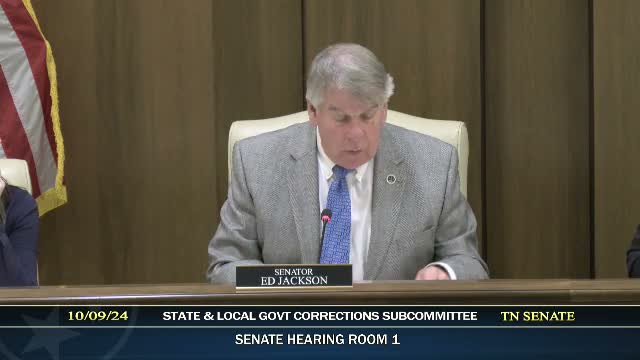
Chairman Jackson and other senators praised the program’s outcomes and asked the group to provide follow-up contacts and details about scaling, particularly in Rutherford, Montgomery and Shelby counties. The Project Return representatives said they were expanding in Chattanooga and exploring other Middle Tennessee satellite locations pending funding.
The committee did not take formal action on the testimony. The next procedural step offered by members was to keep the group’s contact information on file for further discussions about state funding and possible cross-agency coordination.