Get Full Government Meeting Transcripts, Videos, & Alerts Forever!
Get email alerts on the Traffic Calming topic
No spam. Unsubscribe anytime.
Council orders traffic-calming policy after heated debate over Holmes Road
Summary
Council unanimously approved a petition directing staff to develop formal traffic-calming standards and committees after extensive debate about the size, visibility and emergency-service impacts of recent raised crosswalks, especially on Holmes Road.
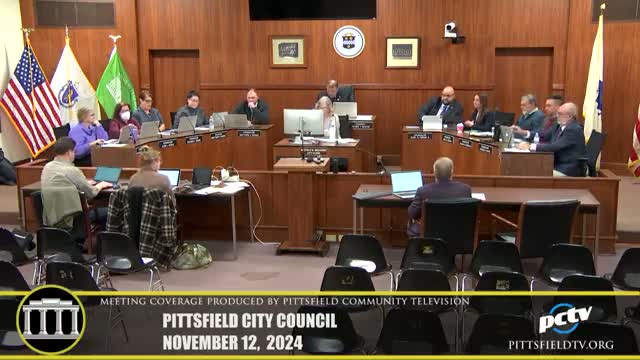
After an extended discussion that focused repeatedly on Holmes Road's new raised crosswalk and other recent traffic-calming installations, the Pittsfield City Council voted unanimously to have the administration develop a formal traffic-calming policy and a public process under a newly awarded federal grant.
Commissioner Morales told the council the city's federal grant (SS4A program) will pay for three deliverables: (1) a Pittsfield-specific traffic-calming policy with technical standards, (2) a resident-facing process for submitting and prioritizing neighborhood requests, and (3) a small pilot program to test measures on selected streets. The plan includes two advisory bodies: a technical advisory committee made up of subject-matter experts (police, fire, transportation) and a community advisory committee with council and public representation.
Councilors raised repeated concerns about Holmes Road, where a raised crosswalk and humps prompted complaints that the feature was too large, poorly visible when unpainted, and caused emergency vehicles to incur damage while crossing. Councillor Persip and others said some installations felt inconsistent in dimension and communication to residents and first responders. Commissioner Morales said designs follow federal and state guidelines and that some installed treatments were intentionally longer and gentler than minimums; he also said the grant process will formalize standards, vet emergency-services concerns and hold public charrettes before final actions.
The council asked for clearer communication with affected neighborhoods and first-responder units before construction, and for pilot projects to include more lead time and signage. The motion approved sends staff to develop the detailed policy and public process, report back with committee membership and timelines in the winter, and present draft standards for council adoption once the public process concludes.
The council's action does not retroactively alter already-completed installations; instead it establishes the formal policy and public-engagement structure to guide future projects.