Get Full Government Meeting Transcripts, Videos, & Alerts Forever!
Get email alerts on the Issues And Concerns topic
No spam. Unsubscribe anytime.
Participants press WDFW on funding, regulatory effect and species management during SWAP briefing
Summary
Attendees asked whether the SWAP is regulatory, how it is funded, how it will inform local permitting, and about controversial topics such as predator management and barred-owl control; WDFW said the plan is informational and funding is mixed across federal, state and partner sources.
During the question-and-answer portion, participants pressed WDFW staff on the plan's regulatory role, funding sources, and species-management practices.
On regulation, Margin Carlson, conservation director at the Department of Fish and Wildlife, said the SWAP is intended as a source of best-available science rather than a regulatory instrument: "The state wildlife action plan isn't regulatory in and of itself," she said, while noting WDFW will tighten links between SGCN and the Priority Habitats and Species database to improve consistency with land-use guidance.
On funding, Wendy Connolly said the SWAP and conservation work rely on multiple sources, not just federal grants. "No," Connolly answered when asked whether the effort is 100% federally funded, and she identified state biodiversity funding, federal grants, local contributions, and partner time as important resources.
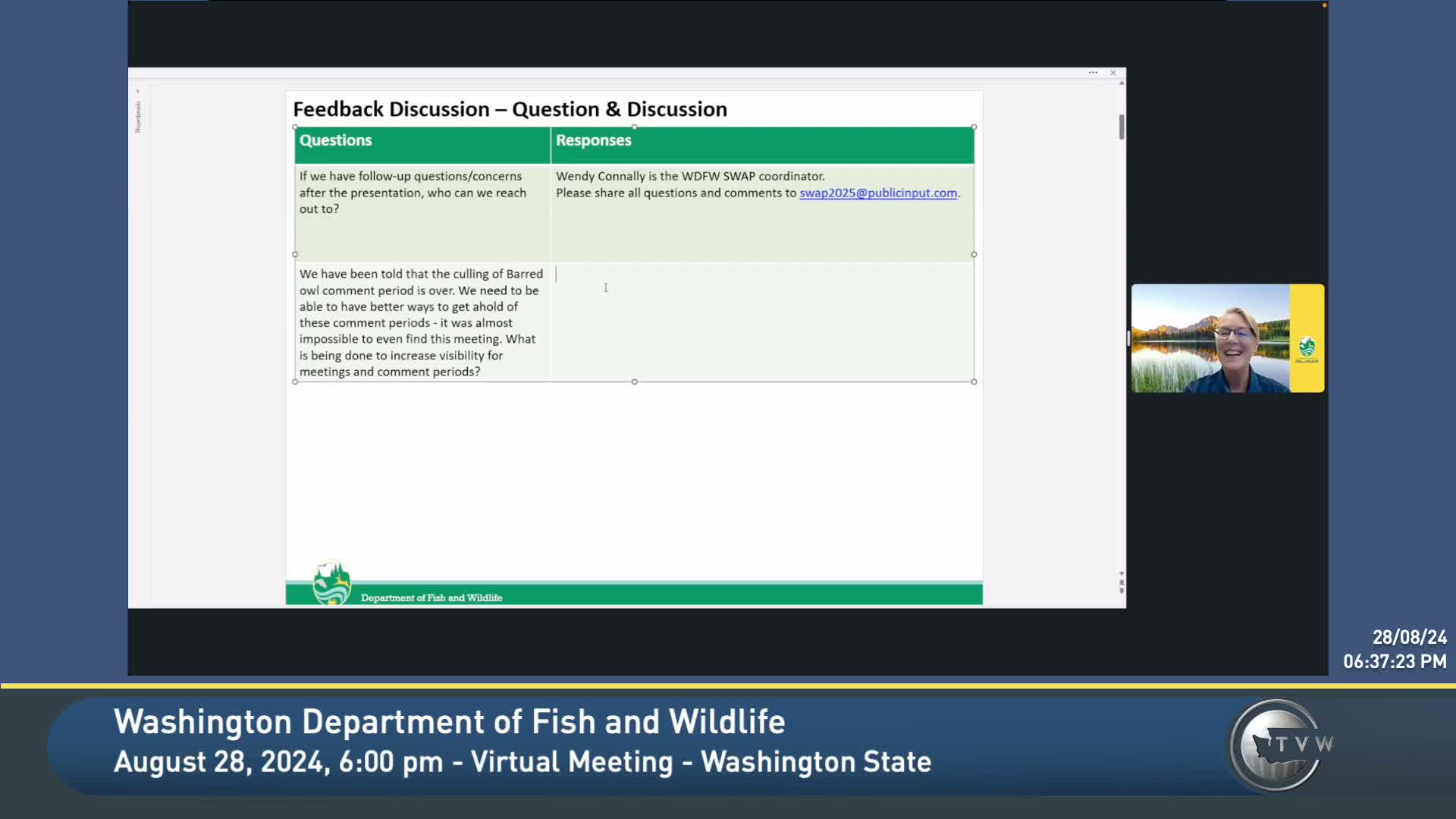
Participants also asked whether predator removal is used to increase hunting opportunities and about the barred-owl controversy. Speakers said predator management is complex, often tied to safety or conflict situations, and not simply to increase harvest. They reiterated that barred-owl management decisions are largely in the U.S. Fish and Wildlife Service domain under the Endangered Species Act, and that lethal control is a controversial, last-resort option in some contexts.
On interagency work, WDFW described coordination with the Washington Department of Transportation to identify and fix blocked culverts and to monitor fish passage restoration, and noted the Department of Ecology leads on lakeshore herbicide regulation while WDFW provides permits and technical advice.
WDFW said it will answer outstanding chat questions after the meeting and post thematic summaries on the SWAP webpage.