Get Full Government Meeting Transcripts, Videos, & Alerts Forever!
Get email alerts on the Swap Revision topic
No spam. Unsubscribe anytime.
WDFW outlines revision of WashingtonState Wildlife Action Plan, sets Oct. 1, 2025 delivery to U.S. Fish and Wildlife Service
Summary
WDFW officials detailed plans to reorganize the State Wildlife Action Plan by ecoregions, expand species and habitat coverage, and improve public engagement; the agency confirmed the draft will be delivered to the U.S. Fish and Wildlife Service on Oct. 1, 2025.
The Washington Department of Fish and Wildlife said it will deliver its revised State Wildlife Action Plan (SWAP) to the U.S. Fish and Wildlife Service on Oct. 1, 2025, and is reorganizing the plan to be easier to use by people and local partners.
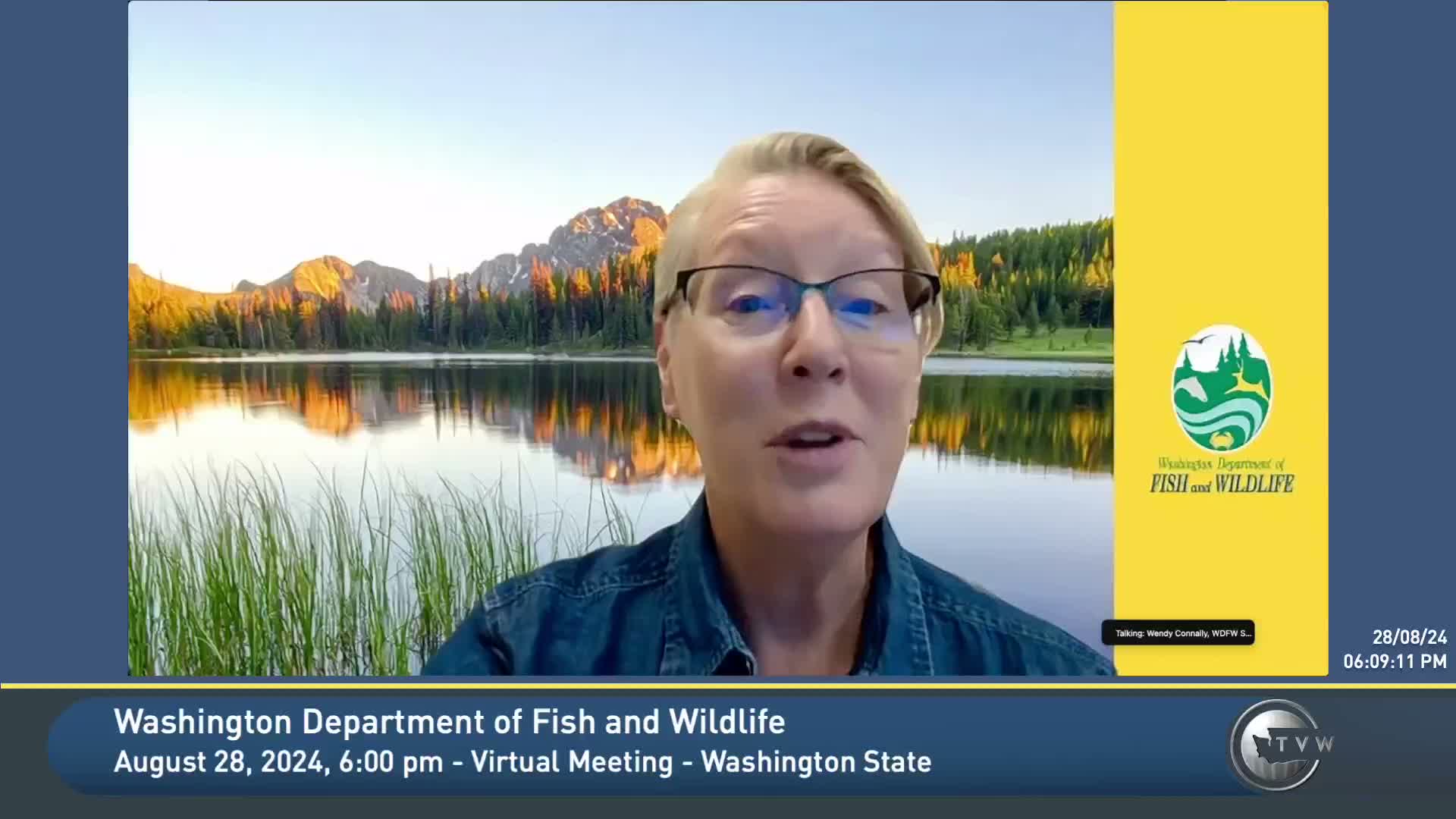
"We are due to deliver this plan to US Fish and Wildlife Service on October 1, 2025," said Wendy Connolly, the state wildlife action plan coordinator. Connolly told attendees the federal review focuses on compliance with eight required elements and does not judge a state's conservation priorities.
WDFW plans to organize the 2025 revision by nine ecoregions and to better connect species, habitats, threats and actions within those geographies, Connolly said. The agency also intends to work with the Department of Natural ResourcesNatural Heritage Program to add plants and imperiled ecosystems as conservation targets and to include actions such as education, outreach and enforcement that were less prominent in the 2015 plan.
"We want the plan to be useful to put more conservation on the ground and more relevant to people who want to engage with all of us in that work," Connolly said. She described an effort to weave climate-change vulnerability, habitat connectivity and landscape benefits into sections rather than treating them as separate chapters.
The 2015 plan included 268 species of greatest conservation need (SGCN); Connolly said WDFW will adopt clearer SGCN criteria for 2025 and add a category for "species of greatest information need" to flag taxa where the habitat risk is known but species-level data are limited.
Connolly and other WDFW presenters emphasized that the SWAP provides best-available-science information for partners and regulators but is not itself a regulatory instrument. "The state wildlife action plan isn't regulatory in and of itself," Margin Carlson, conservation director at the Department of Fish and Wildlife, said, noting that other laws continue to govern specific land-use and permitting decisions.
WDFW said it will post new web content and a series of short videos about each ecoregion and that the draft delivered to the U.S. Fish and Wildlife Service will be posted on the agency website, subject to subsequent regional and federal review.
What happens next: WDFW staff described an internal timeline that includes compiling expert inputs through late winter, drafting in early 2025, director-level review in August 2025, and the Oct. 1, 2025 transmittal to federal reviewers.