Get Full Government Meeting Transcripts, Videos, & Alerts Forever!
Get email alerts on the Public Notices topic
No spam. Unsubscribe anytime.
Watertown council backs petition to let cities publish legal notices online, sparking debate over website reliability
Summary
The council voted to request special legislation allowing electronic publication of legal notices—potentially reducing costly print ads—after staff argued it would improve notice reach. Councilors questioned criteria for qualifying websites, the city’s responsibility for errors and implications for local journalism.
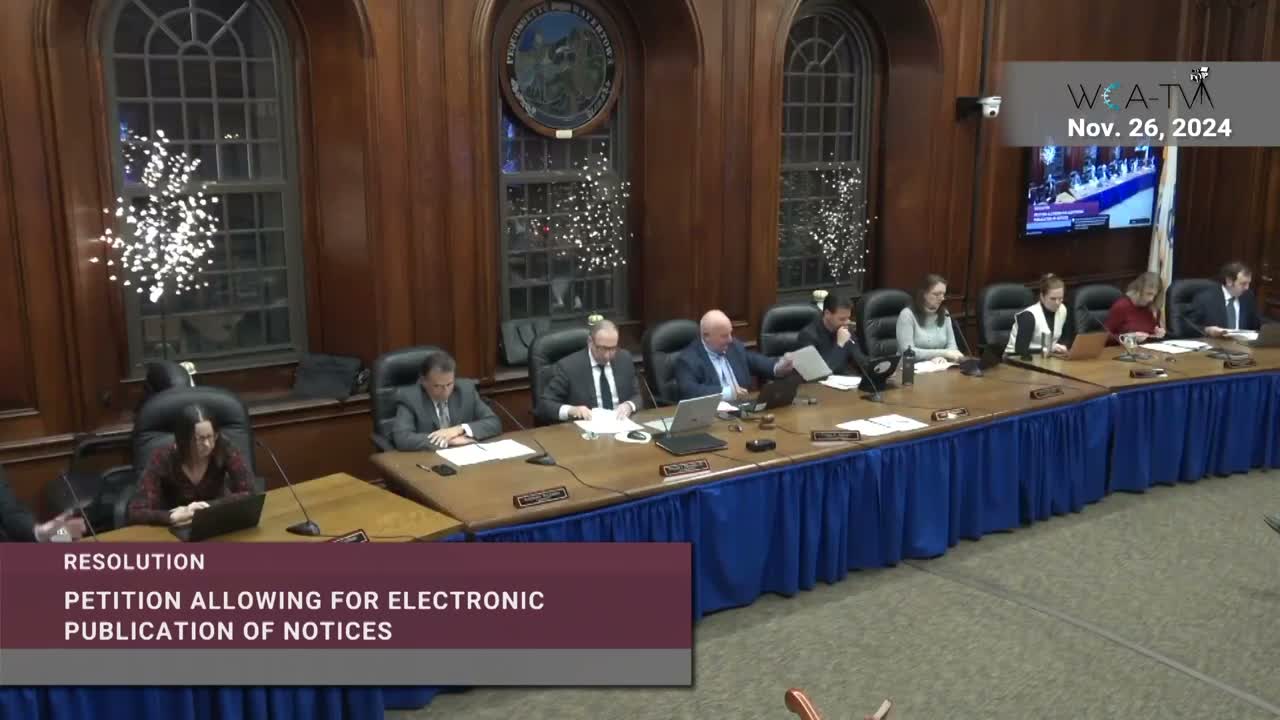
Watertown City Council voted Nov. 26 to request special legislation that would allow the city to satisfy certain legal-notice publication requirements through electronic publication, including local news websites and the city’s own site.
City Manager argued the change could save the city substantial money in legal-ad costs and better reach residents. “Posting something on page 65 of the print edition of the Saturday Boston Globe isn’t exactly the thing that is causing people to become most likely aware of what’s going on in Watertown,” he said, while noting the proposal cannot guarantee passage in the Legislature.
The nut graf: Supporters said the resolution would reduce repeated, expensive print advertising with limited local reach and align the city with other municipalities seeking home-rule flexibility. Opponents pressed for clearer standards and safeguards before replacing print notices.
City Attorney Rich told the council the petition would not remove any statutory requirements for abutter notification in planning or zoning cases and is intended as a compliance-aware ‘‘backstop.’’ He referenced Chapter 4, Section 13B of the general laws as the statutory definition that governs digital-publication criteria and said the petition was drafted to be more format-compliant than some earlier local bills. “This is not intended to avoid any of the other notification procedures,” Rich said.
Several councilors said they support modernizing notice rules but asked for guardrails. Councilor Feltner said he was hesitant because of reliability problems with the city website and asked how the city would address failures to post: “Things are wrong…there’s been instances where things have not been posted.” Attorney Rich and the manager both responded that the city would remain responsible for errors and omissions, regardless of publication method: “If someone shows up here and says a notice is wrong, we’re responsible for that.”
Councilors also pressed for clarity on which online outlets would qualify. Attorney Rich and other speakers noted the statutory definition requires that a qualifying ‘‘website reporting local news and opinion’’ satisfy criteria in Section 13B (print publication, the newspaper’s website and a statewide repository as options), and that a statewide repository (masspublicnotices.org) already hosts many municipal notices.
The measure’s supporters argued the city could combine the local website plus the city’s own webpage (and optionally a statewide repository or news site) to meet the requirement while reducing costs. Councilor Gannon cited local online readership metrics to argue local sites may reach more residents than the remaining print options.
After discussion and questions about a minor drafting typo (the manager said staff could correct a scrivener’s error if the council approves), the council approved the resolution by roll call vote.