Get Full Government Meeting Transcripts, Videos, & Alerts Forever!
Get email alerts on the Mpu Exemption topic
No spam. Unsubscribe anytime.
Washington Department of Revenue Seeks Comment on Draft Guidance for MPU Exemption on Software Maintenance Agreements
Summary
The Washington Department of Revenue presented a draft advisory on applying the multiple points‑of‑use (MPU) retail sales tax exemption to bundled software maintenance agreements and invited written comments by Dec. 11, 2024; industry commenters urged more time, clearer rules on when bundles are disqualified, and simpler documentation methods for apportionment.
The Washington State Department of Revenue on Zoom presented a draft Excise Tax Advisory (ETA) explaining how the multiple points‑of‑use (MPU) retail sales tax exemption would apply to bundled software maintenance agreements and asked the public for comment before adoption.
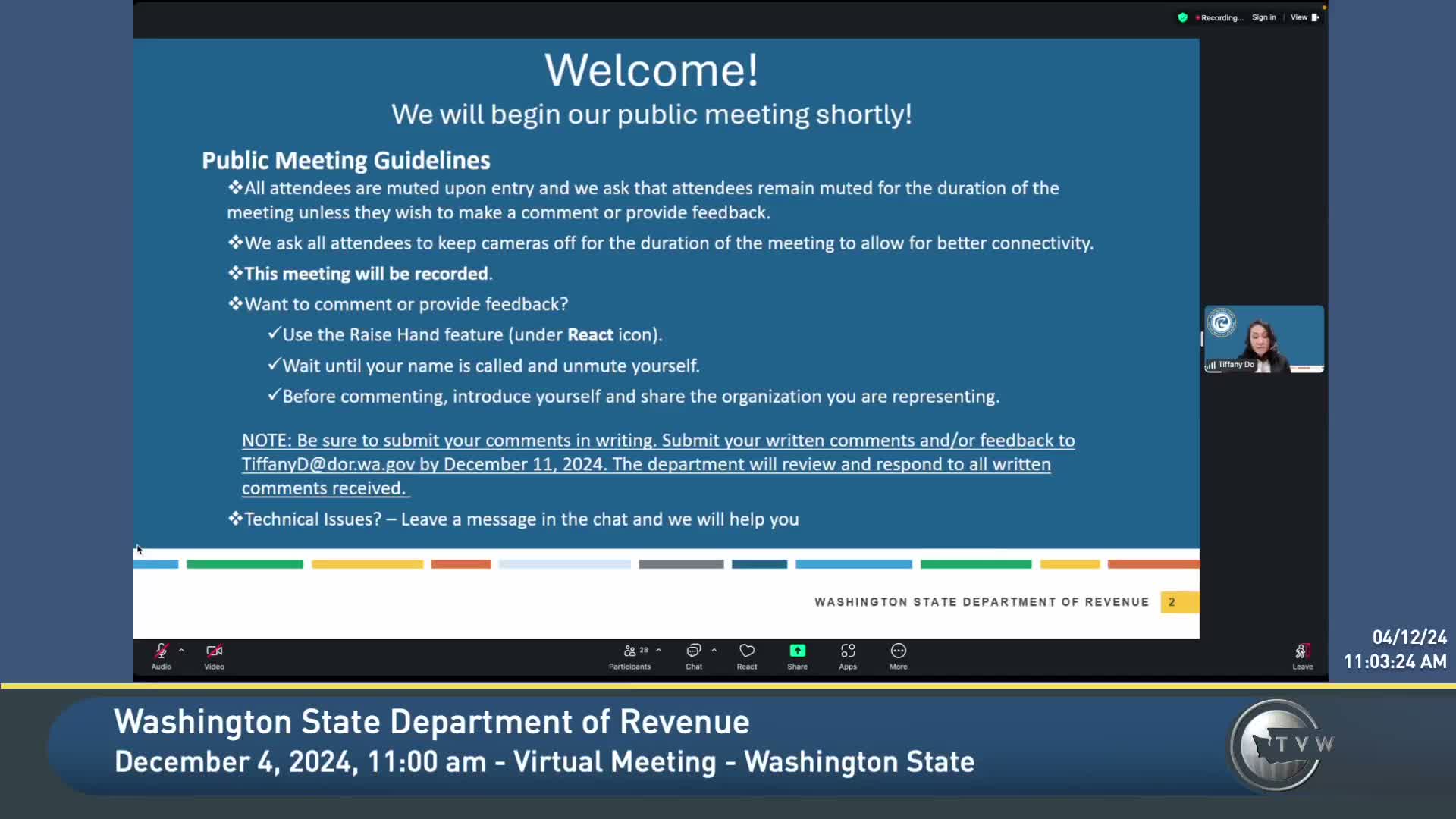
The presenter, a tax policy specialist in the Department's Interpretations and Technical Advice division (Tiffany Doe), said the draft ETA applies only to software maintenance agreements that meet the state's bundled‑transaction rule and that taxpayers must submit written comments by Dec. 11, 2024. "This meeting was announced through publications on the department's website on October 30th, 2024," Doe said, and she provided the draft ETA and examples on the Department's website for review.
The draft ETA sets three conditions for a bundled software maintenance agreement (referred to in the presentation as a NESMA) to qualify for MPU treatment: the bundle must include one or more MPU‑eligible digital products that are concurrently available for use inside and outside Washington; any non‑retail (nontaxable) items in the bundle must relate to and support those MPU‑eligible products; and the only retail‑taxable items in the bundle must be MPU‑eligible products. The presenter emphasized that the MPU retail sales tax exemption does not automatically exempt use tax; when MPU‑eligible products are used inside Washington, the buyer must report and pay the apportioned use tax to the Department in accordance with the ETA's apportionment guidance.
To illustrate apportionment, the Department showed an example in which three MPU‑eligible products have a combined 40 users in Washington and 200 users everywhere, producing a Washington share of 20 percent. "So if the full price for the qualifying NESMA is $200,000, the use tax due or apportioned to Washington is $20,000," the presenter said.
Industry commenters said the draft raises practical and fairness concerns. Caleb Allen of KOM Consulting urged the Department to allow more time for stakeholder engagement and suggested issuing interim guidance followed by a working group. Allen said the ETA, as drafted, "would disqualify an entire bundle 'by proxy' if any enumerated product does not have concurrent users inside and outside Washington," and that approach could be "distortive or unfair." He proposed a holistic apportionment that counts Washington users for each enumerated product rather than disqualifying the whole bundle.
Another commenter identified as Brad made a related point: "If a product is nontaxable, it shouldn't be having any bearing on the eligibility of the MPU eligible items," he said, warning that treating nontaxable support services as determinative of bundle eligibility could create unnecessary disputes and administrative burden.
Darcy Kuyger of Ernst & Young said the guidance is "pretty complex" and warned it could produce a "documentation nightmare" for taxpayers who must substantiate which users use which product where. Kuyger also urged caution about categorical statements in the ETA—for example, treating a customer portal universally as a digital automated service—because prior Department rulings have differed on such questions.
Doe thanked the commenters, reiterated the request for written comments by Dec. 11, 2024 (tiffanyd@dor.wa.gov), and said the Department will review and respond to submitted comments. She also noted that taxpayers may petition for a formal letter ruling where facts differ from the ETA's examples. The meeting adjourned at about 11:51 a.m.; the Department recorded the session and provided links to the draft ETA and the ruling‑request portal in the chat.
What happens next: The Department will review written comments and may revise the ETA before adopting final guidance. Commenters asked for an extended stakeholder process and clearer apportionment language to avoid what they described as disproportionate disqualification of otherwise qualifying MPU products.