Hampton touts $270 million in recent capital investment, outlines strategy to attract jobs and higher‑value housing
Loading...
Summary
Economic Development Director Leonard Sledge updated council on job‑creation, industrial and housing projects, enterprise/tourism zones and workforce strategies; he cited over $270 million in announced capital investment (FY20–FY24) and identified targeted industries and sites including the Phoenix Commerce Center and Constellation mixed‑use project.
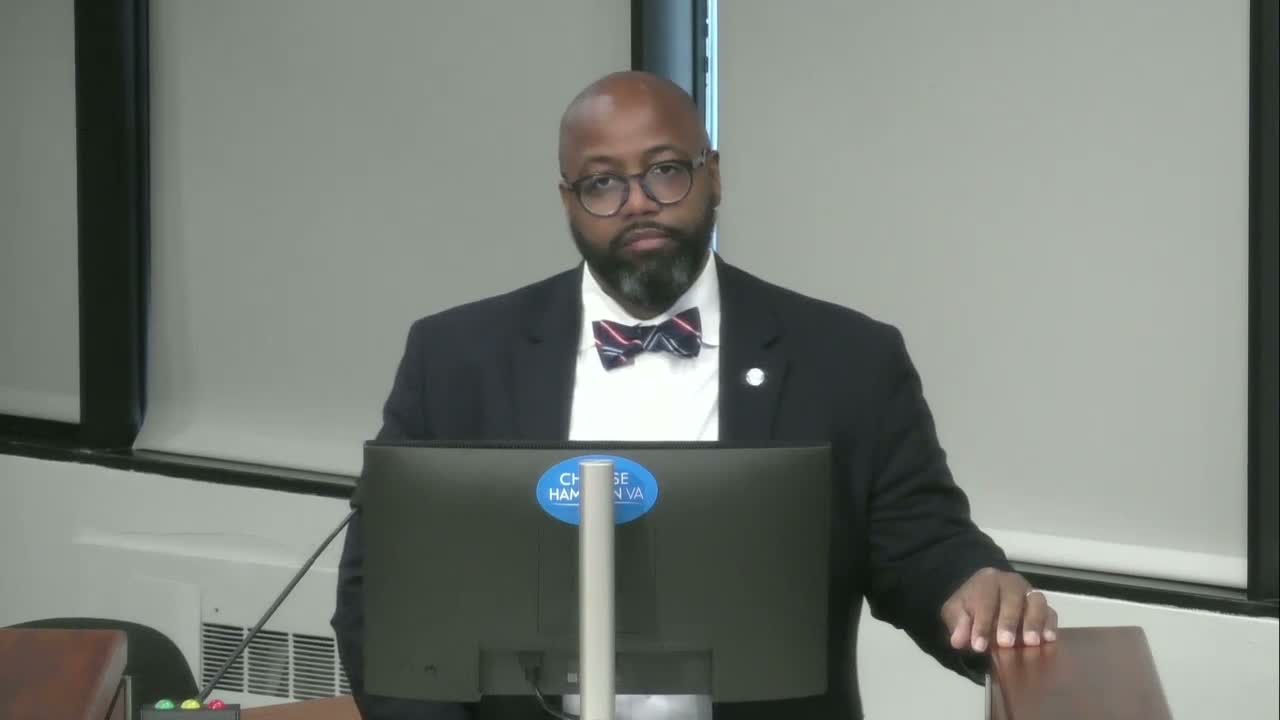
Economic Development Director Leonard Sledge presented a strategic update focused on increasing Hampton’s tax base through business attraction, retail redevelopment, higher‑value housing and tourism.
Sledge opened by saying the department’s work supports city services and quality jobs. He walked council through revenue trends and explained a simple planning metric: at the city’s real‑estate tax rate, roughly $86.2 million of new assessed value generates about $1 million in annual property tax revenue, illustrating why targeted redevelopment matters for long‑term budgets.
Sledge described four strategies—jobs (business attraction, retention and expansion), anchor institutions and workforce development, retail (mixed‑use redevelopment and revitalization of shopping centers), and housing (higher‑value and mixed‑use options). He highlighted anchor institutions that benefit the city, including NASA Langley Research Center, the VA Medical Center and Huntington Ingalls Industries, and cited more than $270 million in announced capital investment the department supported from FY2020 to FY2024.
Projects noted included the Constellation mixed‑use project (approximately $35 million and 125 units, plus nearly 19,000 square feet of commercial space), Trilogy at Lincoln Park (a redevelopment with an executed development agreement cited at roughly $100 million) and the Phoenix Commerce Center and Hampton Logistics Center (industrial space adding new Class A inventory). Sledge said the city is working with state partners and the Hampton Roads Alliance to market sites and prepare shovel‑ready property.
Sledge also described enterprise zone and tourism zone tools (state real property improvement and job‑creation grants and gap financing tied to net new sales tax) and a suite of city grants — facade, manufacturing assistance, retail assistance and tourism/arts grants — used to accelerate investment. He emphasized workforce development partnerships and noted the city’s efforts to assemble land to attract higher‑value housing while continuing programs to support small businesses and minority‑owned firms.
Council members asked questions about how many local residents capture new jobs, the balance of logistics versus advanced manufacturing in new industrial space, and how the city requires hotel room blocks for sports tourism events; Sledge and tourism staff said some event contracts require local room nights when feasible but limited hotel inventory constrains requirements. Sledge closed by offering to provide additional memos on enterprise‑zone activity and opportunity‑zone usage.