Get Full Government Meeting Transcripts, Videos, & Alerts Forever!
Get email alerts on the Emergency And Hormonal Contraceptives topic
No spam. Unsubscribe anytime.
Committee approves DCP rule on emergency contraception after removing pharmacy-transmission requirement
Summary
The committee approved regulation 2024-022A from the Department of Consumer Protection on emergency and hormonal contraceptives, voting to delete a subsection that would have required pharmacies to transmit screening data to the agency amid privacy and operational concerns.
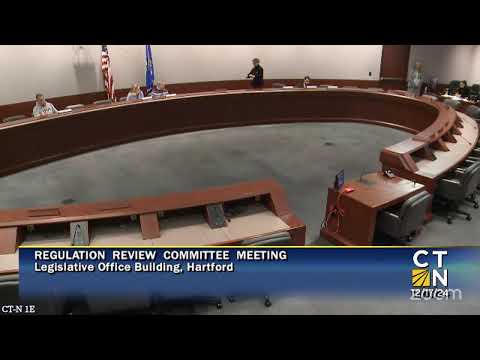
The Legislative Regulation Review Committee considered resubmitted regulation 2024-022A from the Department of Consumer Protection (DCP) governing emergency and hormonal contraceptives. Committee members focused on subsection B, which would have required pharmacies to transmit screening documents to DCP or to the prescription drug monitoring program within a set time frame.
CJ Strand, legislative director for DCP, and Robert (Rob) Marriott, director of the Drug Control Division at DCP, explained that pharmacy screening documents ordinarily remain with the pharmacy and would only be provided to DCP in the context of an investigation or complaint; the Prescription Drug Monitoring Program (PDMP) data are maintained by an outside vendor and accessed for investigative or clinical queries. LCO counsel (Nick Bombace) noted the statute requires pharmacies to make documents available for inspection but does not impose a statutory deadline, and the department used its regulatory authority to add a transmission deadline in the proposed rule.
Several legislators, including Senator Austin, Senator Kelly and Representative Fishbein, expressed privacy and process concerns about the transmission requirement, asking whether patients would receive notice, who would see the data, and whether the department could broadly compel transmission beyond investigations. DCP staff said screening records would not be routinely transmitted to DCP and that transmission would only be used for investigative purposes; Rob Marriott said disclosures would generally be tied to investigations or complaints and would be protected and redacted as appropriate.
To address concerns, the committee agreed to approve the regulation in whole with technical corrections while striking subsection B of section 20-633k-6 (removing the automatic transmission requirement). Senator Kelly and others emphasized that access should be limited to complaint-driven investigations rather than routine transfer of screening records. The administrator conducted a roll call and the motion to approve with deletion of subsection B passed with recorded votes.