Get Full Government Meeting Transcripts, Videos, & Alerts Forever!
Get email alerts on the Education School Funding topic
No spam. Unsubscribe anytime.
New SB 1 Commission on School Funding Kicks Off, Members Set Subgroups and Tight Timeline
Summary
A commission created under SB 1 §36 met to launch work on two reports about school funding and accountability; members introduced themselves, flagged priorities (compensation, reporting, class size, special-education weighting) and asked staff to form subgroups and circulate materials by next week ahead of a Feb. 1 deadline.
Representative Khan opened the commission created under SB 1 §36 on school finance and outlined the panel’s charge: to study funding, accounting and accountability measures for all school operators, with particular attention to alliance districts, charter schools and magnet programs.
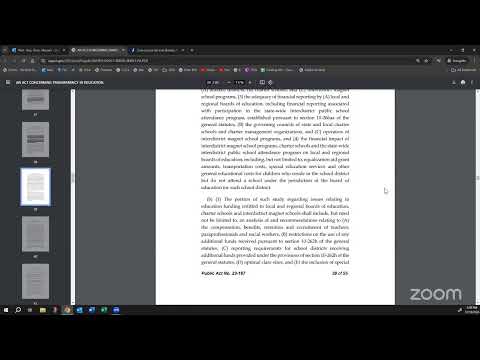
The commission’s first deliverable will be a shorter, descriptive report due in the near term, followed by a larger report next year containing recommendations on finance and accountability. Khan said the first portion’s topics include “analysis and recommendations relating to compensation, benefits, retention, recruitment of teachers, paraprofessionals, and social workers,” restrictions and reporting related to funds under §10-262h of the general statutes, optimal class sizes and adding special education as a need factor in the equalization aid formula.
Members then introduced themselves and the interests they will advance in subgroup work. Amy Turner, assistant superintendent for special education for Wallingford Public Schools and president of Concasse, said she is flexible across topics. Jocelyn Delancey, vice president for the Connecticut Education Association (CEA) and a fifth-grade teacher, said CEA is particularly focused on compensation, benefits and reporting requirements. Cathy Dempsey, assistant executive budget officer at the Office of Policy and Management (OPM) and the secretary’s designee, said budgeting and finance are her priorities. Alex Knopp, the Sheff plaintiffs’ representative and former state lawmaker, said he is interested in magnet school funding and the ECS formula’s treatment of special education. Jessica Brunetti, chief of fiscal administrative services at the State Department of Education and designee for Commissioner Russell Tucker, described budget work as her focus: “All all things budget is kinda my jam.”
Several education and labor groups identified priorities: Sarah Vaca of the Capital Region Education Council (CREC) emphasized magnet school funding and open choice; Lisa Hammersley of the School and State Finance Project highlighted specific statutory subparts on funding; Leslie Blato of AFT Connecticut emphasized reporting and class size; Hamish MacPhail of Khan Can flagged equity and reporting systems; Lou Rosato Burch said he was attending to support CEA colleagues; and Katie Balestracy, chair of the Guilford Board of Education, said she will participate on most calls.
To manage the work, Khan proposed forming three subgroups to cover the statute’s five sections, with staff support to compile deliverables. Staff said forming subgroups should take “not more than a couple of days to a week,” and Khan asked that subgroup assignments and the statutory language be circulated to members by the end of next week (aiming for Friday, with Monday as a backup). Staff and Khan differed briefly on the deadline: staff said they believed it was January, while Khan stated the statutory due date as Feb. 1, creating a short window for subgroup work.
Members confirmed contact information and discussed communication logistics; staff agreed to circulate the meeting link, the statutory language (cited pages approximately 39–49), and participant assignments. Participants noted any intra-group email lists are subject to Freedom of Information rules. Khan closed the meeting by thanking members and reiterating next steps for subgroup formation and materials distribution; Senator McCrory expressed support for a successful process.
The commission did not take formal votes at this meeting. Staff and members scheduled subgroup assignments and materials distribution as the immediate next steps in preparation for the first report.