Get Full Government Meeting Transcripts, Videos, & Alerts Forever!
Get email alerts on the Higher Education Financial Sustainability topic
No spam. Unsubscribe anytime.
Consultant warns enrollment decline and misaligned spending threaten CSCU; recommends governance overhaul and statewide coordination
Summary
An ARPA‑funded consultant study finds Connecticut State Colleges and Universities face persistent enrollment declines, staffing mismatches and unclear governance; it urges a coordinating statewide agency, revised funding rules and targeted actions for Western Connecticut State University.
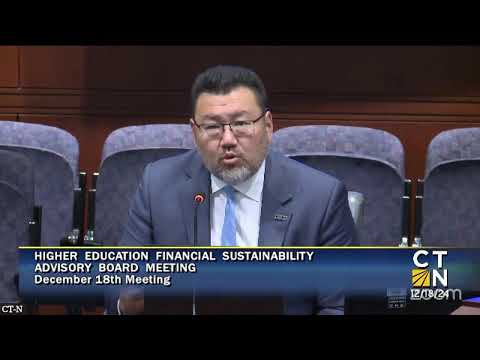
Brian Prescott, president of the National Center for Higher Education Management Systems, told the Higher Education Financial Sustainability Advisory Board that his team’s ARPA‑funded, third‑party study of the Connecticut State Colleges and Universities (CSCU) system documents long‑term enrollment drops and structural issues that threaten fiscal sustainability.
"Enrollment declines are not just happening in Connecticut," Prescott said, summarizing national trends that have hit public comprehensive and two‑year institutions hardest. He cited Western Interstate Commission for Higher Education projections showing Connecticut’s high‑school graduate count is projected to fall about 4 percent between 2023 and 2030, compared with a 10 percent national drop, and warned that declining traditional‑age cohorts combined with lower college‑going rates compound pressure on campus budgets.
The report, Prescott said, rests on federal IPEDS data, Census and state sources, a peer survey conducted with the National Association of State Higher Education Systems, and extensive stakeholder visits and consultations with institutional leaders, faculty, students and employers.
Key findings include:
- A mismatch between enrollment and personnel: staffing levels have not fallen in line with enrollment, leaving a higher employee‑to‑student ratio that exacerbates costs. Prescott emphasized personnel costs typically account for 70–80 percent of institutional budgets.
- Weak system‑level strategy and accountability: the consultant found the system office has not consistently implemented successful shared services or used reserves and other resources strategically to drive systemwide change. Prescott said volunteer board governance and leadership turnover have limited sustained oversight.
- Fragmented state policy: the study identified gaps in statewide coordination, the absence of a single coordinating agency with clear higher‑education policy authority, inconsistent capital‑budget prioritization, and a funding model that does not align incentives with state workforce or affordability goals.
Prescott outlined six organizational options: retain the current structure but bolster accountability; dissolve the system into individually accredited institutions; designate a member institution to perform system functions; revert toward a pre‑2010 structure with separate institutions; stand up an independent shared‑services organization; or (least politically feasible) incorporate UConn into a single statewide system. He recommended, as the most effective option, creating a new statewide coordinating board that could fold existing Office of Higher Education functions into a single policy‑leadership body.
The consultant recommended several immediate actions for the system office, including a strategic staffing realignment tied to program priorities, improved internal communications, clearer role definitions distinguishing system office and institutional responsibilities, a thorough space inventory and a moratorium on adding net new square footage until needs and plans are aligned, and a more transparent reserve policy. Prescott singled out Western Connecticut State University as an urgent priority, citing several years of negative reserve activity and ongoing operational strain.
Board members pressed the consultant on specifics. Senator Austin asked whether rising costs drive declining enrollment; Prescott said cost matters—particularly net price for low‑income students—but that questions of value and workforce outcomes also strongly influence student choices. Representatives and senators raised nontraditional/adult learners, the competitive impact of UConn branch campuses, and whether the report had fully parsed non‑instructional staff growth; Prescott said some issues require deeper study and recommended further hearings and data work.
Chancellor D. Chang responded to the presentation and described system actions already underway: an ongoing search for a permanent president for Western Connecticut State University, a partnership with Central Connecticut State University to assist Western (described as a collaborative support arrangement, not a takeover), elimination of the system provost role to reduce duplication, and a biennial proposal to hold tuition flat for two years. Chang said the system will pursue shared services where they add value and return certain functions (such as HR) to institutional control when appropriate.
Secretary Beckham said the advisory board would collect follow‑up questions in writing and explore bringing the consultants back to answer outstanding technical items at the board’s Jan. 6 meeting.
The board held no substantive votes on policy changes during the session; members approved meeting minutes and adjourned by voice vote. The consultant’s recommendations will proceed next as informational input to CSCU leadership, the governor’s office, OPM and the General Assembly, where potential statutory, funding and governance changes would require additional public hearings and legislative action.
What’s next: the advisory board scheduled follow‑up engagement for Jan. 6 to press the consultant on remaining technical questions, and members requested more data on staffing composition, system office budgets and capital‑project prioritization before considering policy changes.