Get Full Government Meeting Transcripts, Videos, & Alerts Forever!
Get email alerts on the Zoning Mbta topic
No spam. Unsubscribe anytime.
Lynn Council votes to document compliance with MBTA Communities Act, removes unenforced footnote
Summary
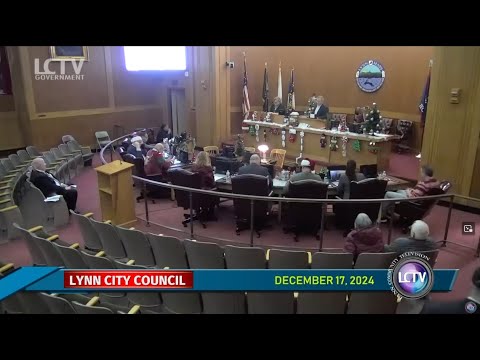
City Council voted Dec. 17 to adopt a zoning amendment to document Lynn’s compliance with the MBTA Communities Act, removing an unenforceable footnote that limited units with more than two bedrooms in the central business district. The change does not alter underlying zoning or review processes, officials said.
Lauren Drago, associate planner for the city of Lynn, told the council the amendment is intended to show Lynn’s compliance with the MBTA Communities Act and to preserve the city’s eligibility for certain state grants.
"This vote will help us be compliant with this new law," Drago said, explaining the city’s proposed 3A district is largely descriptive and "does not change what is allowed on the property" or the review process.
The ordinance deletes a footnote in the city’s CBD regulations that — on paper — limited residential units with more than two bedrooms to no more than 10 percent of dwellings. Drago said that footnote was not enforced because the city lacks the data to determine bedroom-count proportions in the CBD. She told councilors Lynn already has strong by-right multifamily allowances and that the proposed district would more than meet the state’s numeric thresholds: the staff analysis showed a required capacity of 5,517 multifamily units by right and staff estimated a theoretical capacity of roughly 9,400 multifamily units in the proposed district; the district area was presented as about 430 acres and 65% of capacity would fall within a half-mile of the station area.
Councilors asked whether the amendment would spur a sudden rush of development and what the city should do if state litigation (noted in public discussion) changes program rules. Councilor Meany asked whether the city knows how many multifamily units currently exist in the proposed district; Drago said that specific, on-the-ground unit counts were beyond the scope of the staff analysis but that the city’s existing zoning already allows substantial multifamily capacity.
Councilor Field acknowledged he was "reluctant to support this" but said he would do so after speaking with planning staff, noting the city may risk overburdening schools if bedroom counts increase and underscoring the need for state support for schools if housing capacity grows.
After public comment and questions, the council moved, seconded and adopted the amendment on roll-call vote. City staff said the next step is to submit paperwork to the state Department of Housing and Livable Communities to finalize Lynn’s MBTA compliance.
The council’s action removes the unenforced bedroom-count footnote from the zoning code but, according to planning staff, does not itself change what may be built on affected parcels or the review process; broader zoning changes are expected to be considered later as part of a comprehensive zoning rewrite.