Get Full Government Meeting Transcripts, Videos, & Alerts Forever!
Get email alerts on the Short Term Rentals topic
No spam. Unsubscribe anytime.
Hampton narrows short-term rental rules, creates ‘homestay’ category and reduces separation requirement
Summary
The City Council approved three zoning amendments that define a resident-occupied 'homestay' rental, add homestays to the use table with administrative permitting, and reduce short‑term rental separation from 500 to 300 feet; residents voiced concerns about noise, parking and absentee owners during the public hearing.
Hampton City Council on Aug. 14 adopted three zoning changes that separate 'homestay' rentals from short‑term rentals and ease separation limits for short‑term rental permits.
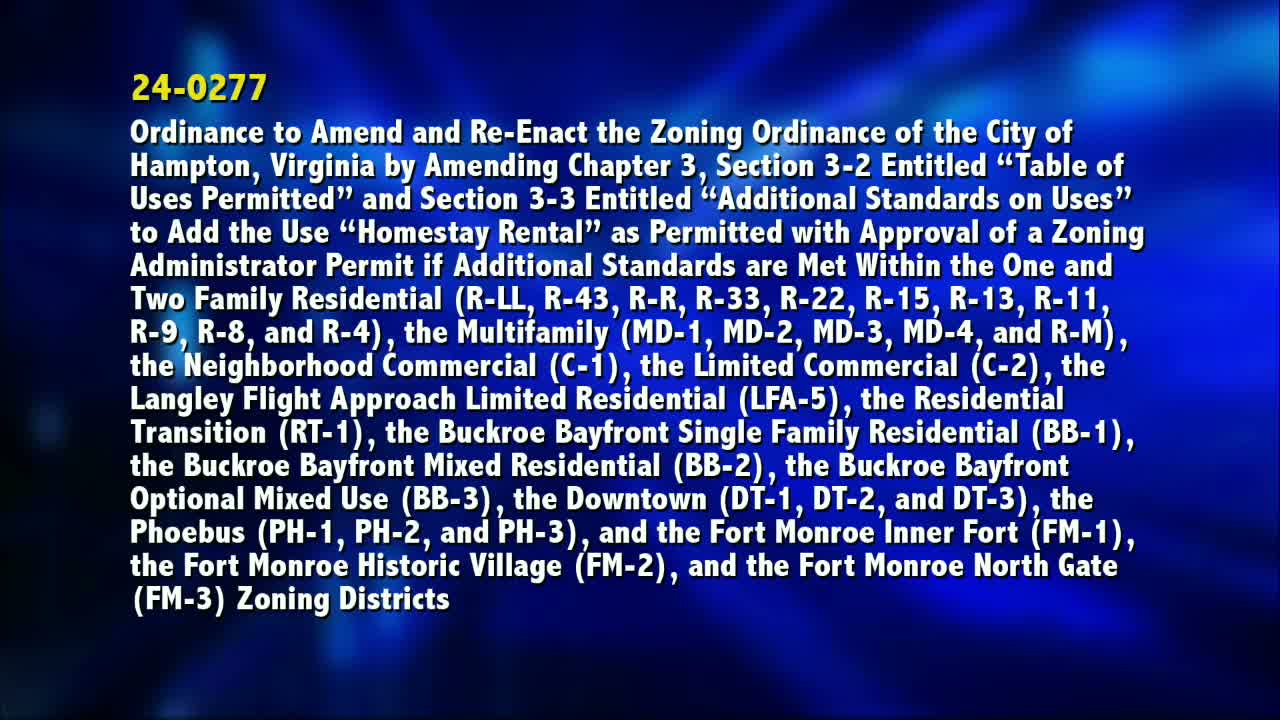
The council voted to add a defined homestay rental as a resident‑occupied dwelling that may rent a single bedroom to transient guests (stays of 30 days or less) and to allow that use by zoning administrator permit in specified single‑family and attached housing districts. Under the ordinance, the operator must live in the home as a primary resident, provide proof of residency upon request, post an approved floor plan and fact sheet, supply on‑site parking, be physically present between 10 p.m. and 7 a.m., and respond within one hour to city complaints.
"If you have family or friends staying and you are not charging them rent, that is not part of the homestay rental," staff told Councilwoman Hope Harper during the meeting, clarifying that noncommercial guest stays are excluded.
The council also approved an amendment reducing the minimum separation between short‑term rentals from 500 feet to 300 feet, a change staff said aligns with other neighborhood measurement practices and would allow some pending applications to qualify where a 500‑foot buffer would have disqualified them. The council adopted the homestay definition and use‑table change unanimously; the separation change passed with one no vote (Councilwoman Mugler).
The public hearing drew more than a half dozen speakers. Theresa Roundy described repeated late‑night parties and parking problems she experienced near an Airbnb and urged council to prohibit short‑term rentals in residential neighborhoods. Jill Rondeau said moving from a 500‑foot buffer to 300 feet would increase density of short‑term rentals and harm property values, arguing the recently adopted regulations have not yet been fully evaluated. Scott Woodruff and others described trash and parking problems associated with homes operated by out‑of‑town owners.
Not all public comment opposed the changes: Angela Evans, a registered nurse, described how short‑term rentals can help traveling medical personnel and said she had used Airbnb for family events.
After the vote, staff said homestays will be reviewed administratively (no public hearing) under conditions intended to limit nuisance complaints and allow enforcement based on residency, capacity and parking requirements. The new rules join already adopted short‑term rental regulations that go into effect Sept. 1.