Get Full Government Meeting Transcripts, Videos, & Alerts Forever!
Get email alerts on the School Governance topic
No spam. Unsubscribe anytime.
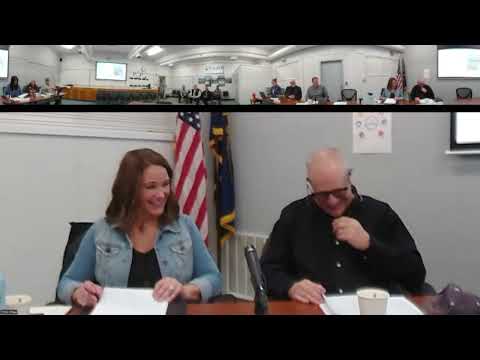
Molalla River SD 35 board votes unanimously to oppose three OSBA ballot items
Summary
At its Nov. 21 work session, the Molalla River School District board voted unanimously to oppose three Oregon School Boards Association ballot items — an amended dues schedule, a new members' caucus and related bylaw changes — after members raised concerns about representation and priorities.
The Molalla River School District board on Nov. 21 voted unanimously to oppose three items on the Oregon School Boards Association (OSBA) ballot, saying the proposals risked diluting regular members’ influence and did not focus the association on improving student outcomes.
The board considered three separate items: a proposed amendment to the OSBA dues schedule, a proposal to create an OSBA members’ caucus that would designate an extra seat on the OSBA board and legislative policy committee, and bylaw amendments tied to that caucus. Speaker 2, the meeting chair, introduced the ballot and said the district must submit its choices by Dec. 15.
Board members aired strong objections during debate. Board member (Speaker 9) said OSBA should prioritize student proficiency, arguing "the proficiency numbers for English and math are completely unacceptable statewide" and urging focus on student outcomes rather than expanding internal structures. A different board member (Speaker 1) said the proposed caucuses "dilut[e] the influence of all of the other board members" by giving extra votes to special-interest caucuses. Speaker 7 also urged opposition, saying the caucus approach risked shifting attention away from the district’s core work.
After discussion, Speaker 9 moved that the district vote "no, do not adopt" on the dues amendment (resolution 1); Speaker 2 seconded. The board raised hands and the chair declared the motion passed unanimously. The board then moved separately on resolution 2 (the caucus) and resolution 3 (bylaw amendments related to the caucus). Speaker 7 moved to vote "no, do not adopt" on resolution 2 and Speaker 1 moved to oppose the bylaw amendments in resolution 3; both motions were seconded and both passed unanimously.
Board members framed their votes as a way to register dissatisfaction with OSBA direction while acknowledging that, because OSBA has a larger membership base, a statewide vote could still carry the proposals. "No matter how we vote, whether it's no or whether we don't vote, this resolution is gonna pass," Speaker 1 said, noting the district’s vote was intended as a signal. The board instructed the chair and district staff to complete the ballot paperwork reflecting the board’s positions.
What happens next: The district will submit the completed OSBA ballot as recorded at the meeting. The board did not take further formal action to withdraw from OSBA or alter its membership; several members noted alternatives exist but emphasized the district currently relies on OSBA services, including policy support and pooled liability insurance.
The decision was procedural: the board merely recorded its choices for the OSBA ballot rather than adopting a new district policy.