Get Full Government Meeting Transcripts, Videos, & Alerts Forever!
Get email alerts on the Reentry Services topic
No spam. Unsubscribe anytime.
CCJBH: Medi‑Cal enrollment high after prison release but behavioral‑health service use remains low
Summary
CCJBH staff reported that roughly three‑quarters of people released from CDCR in FY 2019–20 enrolled in Medi‑Cal within a year, but penetration and engagement with behavioral‑health services were low relative to identified need; COVID‑era expedited releases initially had faster managed‑care plan selection.
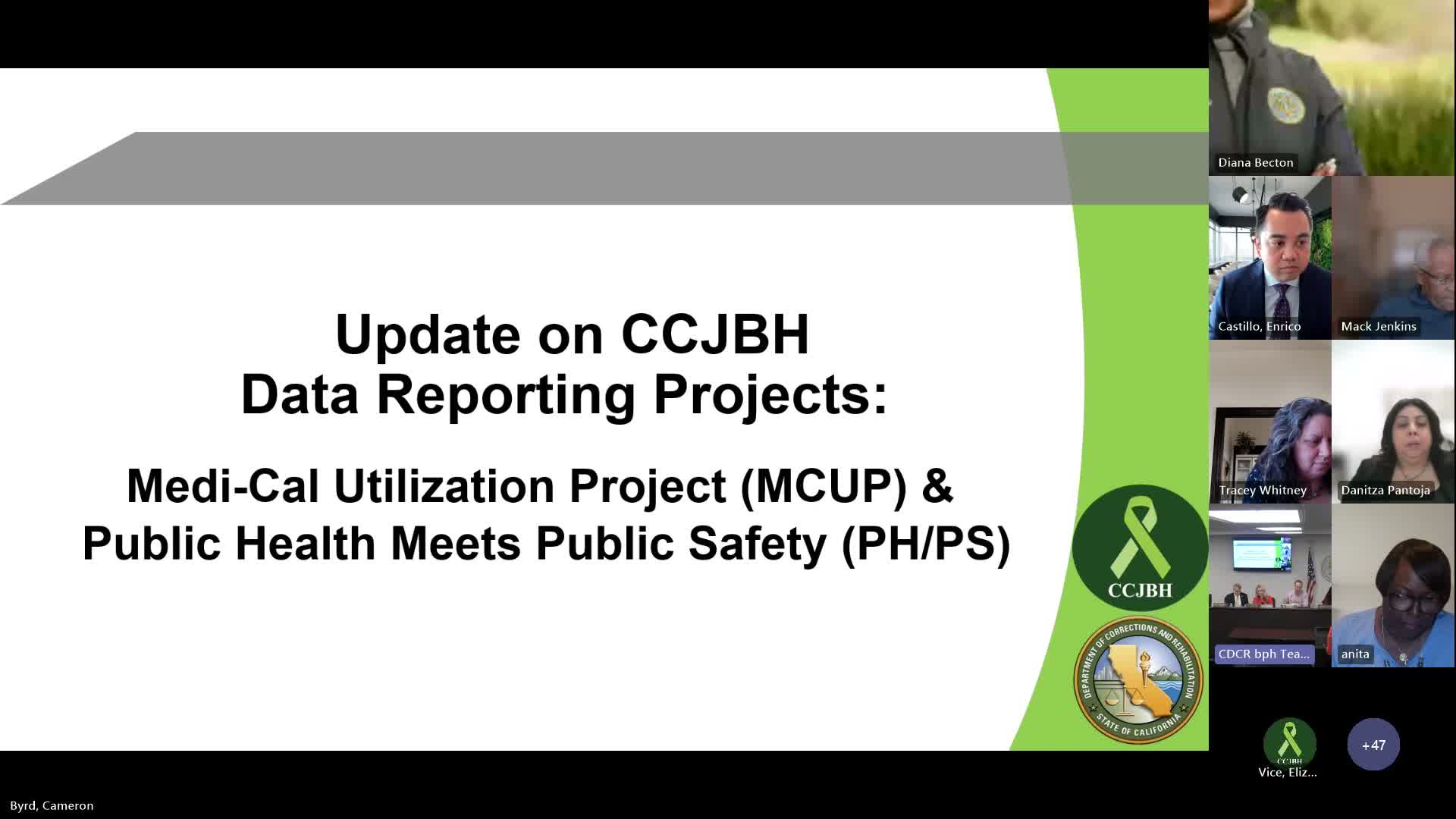
Camilla Holloway, CCJBH research scientist, presented the Medi‑Cal Utilization Project (MCUP) findings at the March 22 meeting. The MCUP matches CDCR release data to DHCS Medi‑Cal enrollment and claims to measure enrollment and behavioral‑health service use among people released from state prison.
Holloway reported that for FY 2019–20 releases, 76% were enrolled in Medi‑Cal within one year. Managed‑care plan selection lagged initially (22% selected within one month, 55% within three months, 71% within six months and 81% within a year), but overall enrollment within two years remained similar to prior cohorts. She summarized demographics for the cohort: 92% male, 65% ages 25–44, and racial/ethnic breakdowns of 36% Hispanic, 23% white and 20% Black; CDCR identified a behavioral health need for 76.5% of the cohort at release.
Despite enrollment, behavioral‑health utilization rates were low relative to identified need. Holloway gave penetration (1+ service) and engagement (5+ services) examples: among those recorded with a substance use disorder at release (52% of releases), 19% had any SUD service within two years and 15% met the engagement threshold. Specialty mental health penetration was about 7% overall and engagement 6% (non‑specialty penetration 9%, engagement 3%). In people with co‑occurring SUD and mental health designations, penetration and engagement rates were higher but still well below the share identified with needs.
Holloway said COVID‑expedited releases selected managed care plans much faster in the first month (26% vs 2% for scheduled releases) and had slightly higher early penetration rates, which may reflect concentrated transition efforts during the COVID release period.
Council members and public commenters asked questions about methods (self‑report vs validated diagnoses), how CalAIM and the Justice‑Involved initiative could improve connections, and the role of pre‑release 90‑day in‑reach and peer supports. Holloway emphasized that MCUP uses administrative matches and that the team is working to add later release cohorts and examine enhanced care management (ECM) and community support service utilization. A DHCS representative confirmed that the ECM benefit is live and can provide housing‑related supportive services through Medi‑Cal managed care plans.
CCJBH staff said next steps include matching additional release years (FY 2020‑21 and 2021‑22), exploring ECM and Community Support usage, and publishing updated reports. Council members urged stronger pre‑release enrollment and warm handoffs (peers, parole/probation case planning) to increase utilization.