Get Full Government Meeting Transcripts, Videos, & Alerts Forever!
Get email alerts on the Rent Stabilization topic
No spam. Unsubscribe anytime.
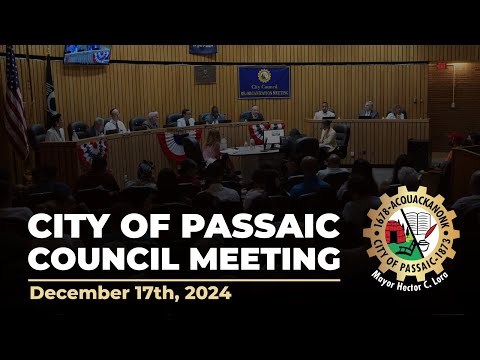
Passaic council approves first reading of rent-stabilization ordinance after heated debate
Summary
Passaic City Council held a prolonged public hearing and voted to approve the rent-stabilization ordinance for first reading, setting a Jan. 7, 2025 second reading. The ordinance creates a rent-leveling board, includes a 6-year sunset, a pathway for below‑market units to increase toward HUD regional benchmarks, and exempts new construction for the life of the mortgage.
Passaic City Council voted on Dec. 6 to advance a proposed rent-stabilization ordinance to second reading on Jan. 7, 2025, following several hours of public comment and council debate.
The ordinance would establish a three-member rent-leveling board (plus three alternates) to review landlord requests to raise rents beyond limits set in the measure; the administration and the council’s rent-leveling attorney described a structure that requires one landlord, one tenant and a third member who may be designated as an "expert" (or, under a proposed amendment, an identified homeowner). The ordinance includes a six-year sunset and a pathway allowing owners of units far below market to increase rents by up to 20% per year until reaching a HUD regional benchmark, after which the ordinance’s ordinary limits apply.
Mayor Hector Laura and other proponents framed the proposal as a measured response to what they described as frequent and sometimes “exorbitant” rent increases confronting vulnerable residents. The mayor told the council the proposal was intended to give tenants a faster administrative forum and to avoid more extreme policies. Rent-leveling attorney Christopher Rodriguez explained technical details and exemptions, telling council members that new construction would be exempt from the ordinance for the life of the mortgage and that hardship and capital-improvement pathways would remain available for landlords seeking higher rent adjustments.
Opponents, including Councilman Schwartz and others, warned of unintended market and fiscal consequences: they argued any cap or regulation could reduce investor appetite for new projects, lower property valuations used for tax assessments, and prompt appeals that shift tax burdens to homeowners. Council members asked for clarifications on vacancy decontrol, which units the ordinance would cover, and how the proposed homeowner designation would interact with the current ordinance categories of landlord, tenant, and expert.
Council discussion produced several clarifications recorded on the record: the board’s member terms were described as four years; the city’s packet cited regional HUD rent tables (a two-bedroom low-income benchmark of roughly 14.58 per HUD materials was discussed during the hearing); staff said the ordinance would apply to existing properties and not to new construction for the mortgage term; and the measure contains a hardship clause and capital-improvement criteria to guide exceptional increases. Rent-leveling attorney Christopher Rodriguez said the city had handled more than 55 matters and issued over 65 letters related to tenant-landlord complaints in the last two years, noting that an established board could bring more consistency and speed to dispute resolution.
After extended debate about market effects and the proper balance of representation, council members moved and seconded a vote to approve ordinance 44 for first reading; a roll-call vote was recorded and the measure advanced to a Jan. 7, 2025 second reading. Council also agreed to defer formal appointments to the rent-leveling board (item 43B) to the next meeting, pending further review of candidate classifications under the current ordinance.
The next procedural step is the ordinance’s second reading and public hearing, scheduled Jan. 7, 2025. If adopted after second reading, the ordinance would take effect according to dates specified in the final approved text, and the council would then return to finalize appointments to the rent-leveling board.