Get Full Government Meeting Transcripts, Videos, & Alerts Forever!
Get email alerts on the Open Container Policy topic
No spam. Unsubscribe anytime.
Milwaukie council opens discussion on event‑based downtown open‑container policy; staff to return with liability, insurance and pilot options
Summary
Councilors, police and business owners discussed allowing packaged alcoholic beverages in designated downtown event zones. Police urged caution over public‑safety, enforcement and insurance implications; business speakers urged event pilots to boost foot traffic. Staff will research liabilities and return with options in early 2025.
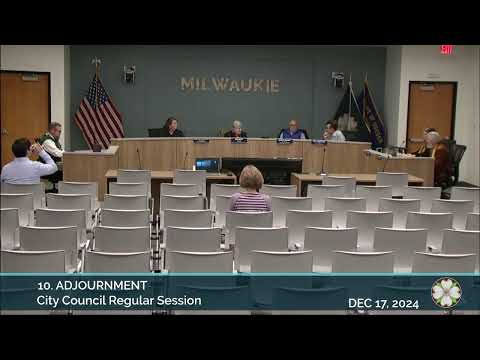
Milwaukie’s City Council spent its Dec. 17 meeting debating whether to loosen the city’s long‑standing open‑container restrictions to allow people to carry and consume packaged alcoholic beverages within designated downtown event zones.
Police Chief Ryan Burdick framed the discussion as an initial public‑safety scan, noting Milwaukie’s municipal code from 1993 already prohibits open containers and carries a fine. Burdick warned that designated open‑container zones can raise public‑safety and liability concerns — from increased intoxication, disorderly conduct and theft to strains on police resources and higher insurance costs — and said the city has mainly anecdotal data rather than formal surveys on how such changes affect calls for service.
Why it matters: business owners say event‑focused open‑container permissions can spread foot traffic across downtown, support vendors and revive events such as First Friday and the summer concert series. Opponents and some councilors cited public‑health and equity risks if enforcement is applied unevenly, and noted the potential cost of added monitoring or policing.
During public testimony, Mike Lesch, co‑owner of Beers for Milwaukie, described event‑focused rules that would allow packaged beers, wine and seltzers sold from downtown establishments to be carried across event zones so visitors “can walk down the waterfront with a beer” and visit multiple businesses. Karen Bernick, owner of Milwaukie Spine and Sport, said relaxing rules for specific events could “breathe new life into our local businesses.”
Councilors pressed staff on data and implementation. Councilor Anderson asked for comparative data from other cities and what metrics the city would use to evaluate a pilot; Chief Burdick said the department would dig deeper into relevant data points, such as prior sobering‑center transports and calls for service, but that citation counts are not a complete measure because officers often prioritize voluntary compliance.
City staff and the mayor raised multiple implementation issues that would need resolution before any change: defining geographic boundaries, coordinating with the Oregon Liquor and Cannabis Commission on special‑event requirements, insurance and indemnification levels for event permits, whether to tie allowances to specific permits or create an entertainment district, and how to monitor equity of enforcement.
What’s next: staff said it will research liability, insurance, penalty levels and examples from other municipalities and return with scalable options (including small, event‑focused pilots) in early 2025. No ordinance or vote occurred at the meeting.
Representative quotes: “Allowing packaged products sold from downtown stores would let people visit multiple venues instead of staying in one place,” Mike Lesch said in public testimony.
“Some of the public‑safety concerns are increased risk of disorderly behavior related to intoxication,” Police Chief Ryan Burdick told council.
Council reaction and context: Several council members said they preferred a cautious, incremental approach — testing event‑based pilots rather than opening a full entertainment district — and asked staff to include public‑health and recovery partners in future conversations. One councilor also urged staff to consider removing or lowering monetary penalties if the city formally changes enforcement approaches to avoid disproportionate impacts.
The council did not vote on policy changes; staff will return with research and proposed next steps for council consideration.