
Lytle's Fork advisory board urges Scott County to fund basic amenities, maintenance and signage
Get AI-powered insights, summaries, and transcripts
Subscribe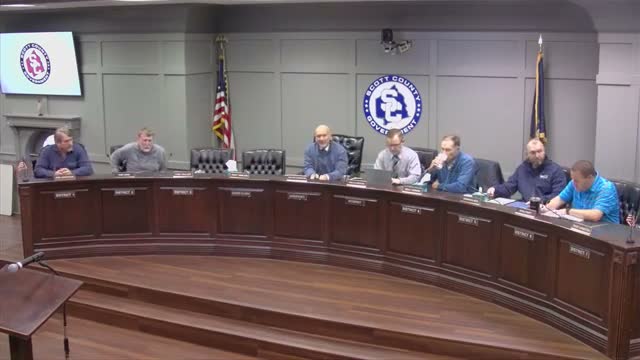
Summary
The Lytle's Fork advisory board told the Scott County Fiscal Court the 1,400-acre property is a state-scale asset built largely by volunteers and asked the court to consider budget items — mowing, temporary toilets, signage, a pavilion and phased maintenance — as visitation grows.
Temple Jewett, a member of the Lytle's Fork advisory board, told the Scott County Fiscal Court the property is "a treasure" and "something that is big in terms of across the state," and urged the court to consider modest budget support to sustain growing public use.
Jewett summarized the site: acquired in the 1980s–1990s, originally planned as a reservoir, and now approximately 1,400 acres with bike and horse trails, a walking bridge and volunteer-built benches and signage. She credited volunteer groups including Kimba and the Riders Up group for constructing trails and amenities but warned, "volunteerism is probably not going to keep up with what we're trying to do," saying on-site monitoring and dedicated staffing will likely be required as use increases.
The advisory board cited recent events and programs to show rising demand: the Bluegrass Mountain Cup race drew about 60 participants, and school field trips and a request from Scott County High School’s cross-country coach indicate growing recreational and educational use. Jewett said the board has bylaws, an operations plan, rules of use and a forest stewardship plan, and has begun outreach to partners such as the forestry service, the American Chestnut Foundation and county tourism staff to track and manage visitation.
Near-term requests the board asked the court to consider during upcoming 2025–26 budget discussions include increasing mowing frequency, piloting temporary bathroom facilities (porta-potties) before committing to permanent vault toilets, improving signage and wayfinding, building a pavilion/picnic shelter and developing a maintained website. Speakers described a recent mowing contract of roughly $3,000 and noted the county previously placed $60,000 in JR’s budget last year for reservoir-related work; one speaker estimated a vault toilet at about $35,000 while another cautioned that higher-end federal-style installations can cost substantially more.
Speakers also flagged constraints and risks: Lytle's Fork is a blue-line stream that falls under the U.S. Army Corps of Engineers, meaning any work in the stream bed requires permits and engineering; vandalism has been minimal so far but could increase with visitation; and trash receptacles were not recommended without reliable monitoring because they could lead to piles of garbage. The group discussed making phased trail improvements, mapping loops for different user abilities and exploring university partnerships and tourism outreach to support design and wayfinding.
Court members and advisory board volunteers agreed to follow up: the advisory board will share detailed materials and the court asked staff to include near-term items as part of budget planning. The meeting concluded with plans for site visits to EMS and the sheriff's office so officials can view construction and conditions on the ground before finalizing proposals.