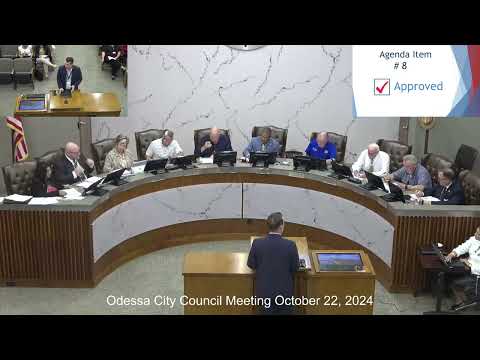
Odessa council approves amendment to restroom ordinance after hours of public testimony

Odessa City Council · October 23, 2024

Loading...

AI-Generated Content: All content on this page was generated by AI to highlight key points from the meeting. For complete details and context, we recommend watching the full video. so we can fix them.

Summary

Council voted to amend the city's restroom-use code, adopting language that defines biological sex by birth certificate, lists exceptions, and adds civil trespass penalties and a private right of action; the measure drew extensive public comment from both supporters and opponents during a heated debate.

The Odessa City Council approved an amendment to the city code regulating restroom use in public buildings after a lengthy presentation and more than an hour of public comment that sharply divided residents.

Jonathan Sines, an attorney with Texas Values who presented the draft language, framed the change as a clarification rather than a novel restriction. He explained the ordinance would define "biological sex" for restroom assignments using the birth certificate nearest the time of birth and create civil trespass penalties for knowingly entering a restroom "designated for the exclusive use by persons that do not correspond to his or her biological sex," while also enumerating exceptions for minors accompanied by a parent or caregiver, law enforcement duties, medical emergencies and maintenance.

Sines described a private right of action that would allow private citizens — not the city — to bring civil claims for violations, and he cited recent federal decisions and state guidance he said support the city's authority to adopt such rules.

During public comment, supporters emphasized child safety and privacy. Tim Harry said he "absolutely supported this project" earlier in the meeting's ODC discussion and several residents spoke to the need for clear rules. Councilmember Haney moved to approve the amendment.

Opponents included transgender residents, local advocacy groups (including members of OUT in West Texas and PFLAG) and longtime city employees. Gail Norris, who identified herself as transgender and as a city human-resources clerk, told council that the ordinance "will neither provide for nor protect anyone" and warned it would be ineffective to enforce and could invite litigation. Alexander Ermel, president of the Midland-Odessa chapter of PFLAG, said the proposal was "not only unnecessary, but also a complete waste of the city's time, money, and resources."

Other residents raised both civil-liberty and practical enforcement concerns: speakers argued police cannot monitor all restrooms and that a private right of action would encourage nuisance suits and community division. Council members asked questions about enforcement priorities and whether the ordinance would require law enforcement to check records; presenters and staff said the measure is civil in nature and that enforcement mechanisms would rely on complaints and court processes rather than daily policing of restrooms.

When the council called the question, the clerk recorded the motion as passing (transcript records "55 in favor, 2 against"). Council and staff said the implemented changes would be subject to formatting and final legal review before codification.

What's next: staff will prepare the finalized ordinance language for codification and the city attorney's office will ensure format and cross-references are correct before publishing the amended code.