Get Full Government Meeting Transcripts, Videos, & Alerts Forever!
Get email alerts on the Grid Planning topic
No spam. Unsubscribe anytime.
PJM warns of tighter margins, urges state action on siting and replacement generation
Summary
PJM told West Virginia lawmakers that demand growth driven by data centers and electrification is tightening capacity margins in the PJM footprint and urged states to avoid policies that push generators offline before replacements are available; Stanek also explained the federal NIETC corridor process and how DOE funding and FERC permitting could interact with, but not replace, PJM planning.
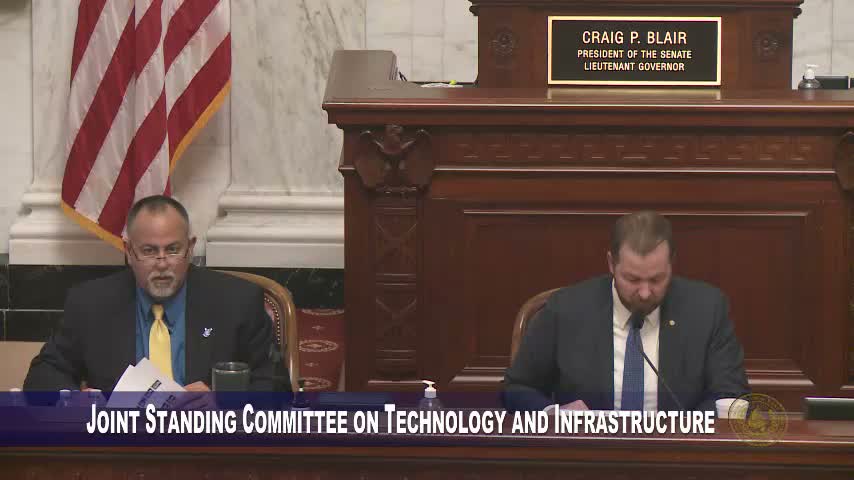
Jason Stanek, a senior PJM executive, told the West Virginia Joint Legislative Committee on Technology and Infrastructure on Dec. 10 that the regional power market is entering a period of tighter capacity margins and that the operator is planning out 15 years to ensure reliability.
Stanek said PJM, which operates the high-voltage grid for parts of 13 states and the District of Columbia, serves about 65 million residents — roughly 1.8 million in West Virginia — and manages more than 88,000 miles of transmission. "We are the largest power grid operator in the United States," he said. He described PJM’s three core functions as running the energy markets, running capacity markets that act like insurance for future output, and providing ancillary services to preserve system stability.
Why it matters: Stanek warned that PJM’s resource mix is changing quickly. PJM’s dispatchable fleet totals about 180,000 megawatts systemwide; West Virginia’s share is roughly 14,000 megawatts, of which about 12,000–12,500 megawatts are coal-fired. He said PJM expects retirements of a large portion of older thermal capacity by 2030 and that policy and unit age are major drivers of those retirements. That reduction, together with rising demand driven principally by data centers and electrification, increases the risk that supply will lag peak needs unless new resources and transmission come online.
On corridors and federal involvement: Stanek reviewed the National Interest Electric Transmission Corridor (NIETC) process established in the Energy Policy Act of 2005 and administered by the U.S. Department of Energy. He said the corridors announced in May are preliminary and vary in size; the Mid‑Atlantic corridor that touches West Virginia is shown as roughly two miles wide on DOE’s maps but would be expected to be finalized as narrower alignments if used. Designation, he said, can make projects eligible for federal loan and financing programs and allow FERC to take certain siting/permitting actions, but PJM does not use NIETC corridors in its day‑to‑day transmission expansion planning.
On the interconnection queue: PJM described a surge in generator interconnection filings that peaked in 2021 and grew the queue to an aggregate on the order of hundreds of thousands of megawatts of proposed projects. After queue reforms filed in June 2022 and approved by FERC later that year, PJM said it has cleared tens of thousands of megawatts of mainly renewable resources for potential development but that many cleared projects remain unbuilt because of permitting delays, financing and supply‑chain constraints.
Policy recommendations: Stanek offered two asks for state lawmakers: first, do not enact policies that would push existing generators off the system until there are adequate and equivalent replacement resources available; second, review state permitting and siting barriers that could be slowing new generation and high‑voltage transmission. "Having resources shut down prematurely without replacement resources is a recipe for disaster," he said.
The committee followed the presentation with questions on EPA-related regulations that PJM has flagged as contributing to retirements, the potential for rate impacts from transmission investments, and whether natural gas is likely to remain the primary thermal backup resource — Stanek said natural gas is the most likely candidate where it can be sited and permitted. The committee did not take formal action on issues raised during the presentation; PJM staff made materials available for follow-up.