Get email alerts on the Restore Patent Rights Act topic
No spam. Unsubscribe anytime.
Senate IP Subcommittee Hears Split Over One‑Sentence Restore Patent Rights Act
Summary
A Senate Judiciary intellectual property subcommittee hearing featured four witnesses split over the Restore Patent Rights Act, which would create a rebuttable presumption favoring injunctions for proven patent infringement; supporters said it protects small inventors, opponents warned it could empower patent assertion entities and chill innovation in complex tech markets.
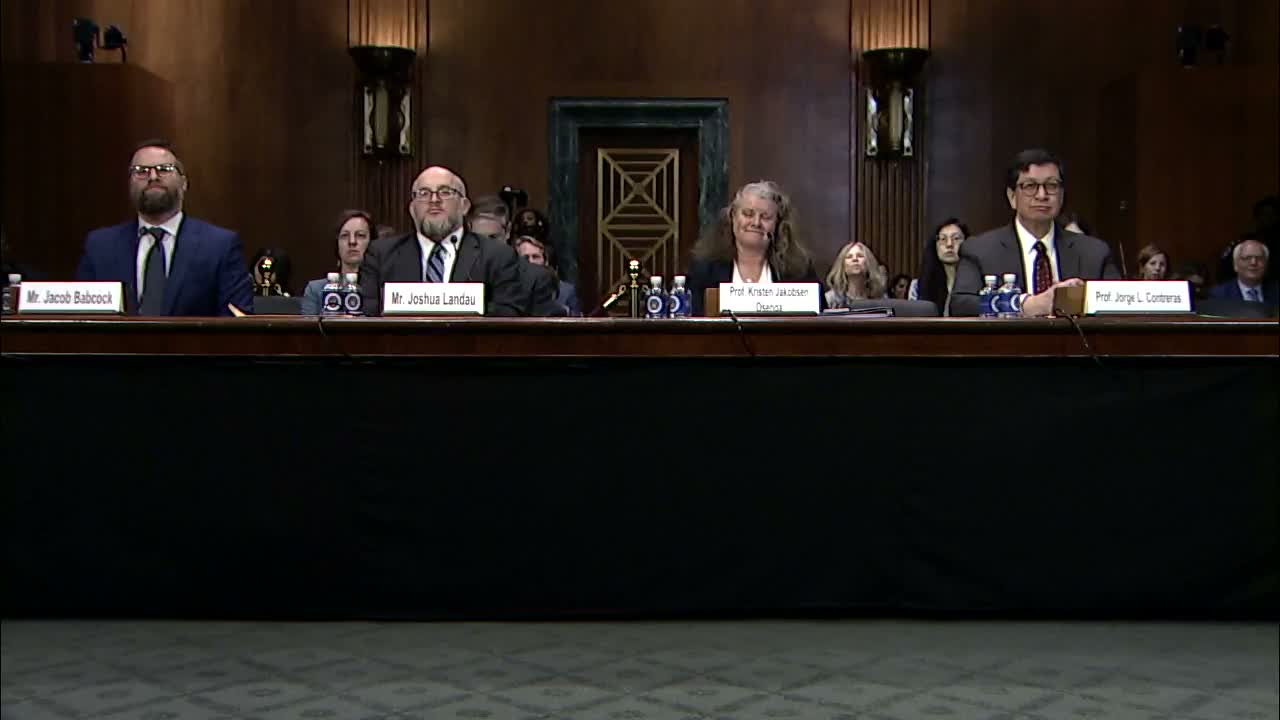
Chairman Koontz convened the intellectual property subcommittee to consider the Restore Patent Rights Act, a one‑sentence proposal cosponsored by Senator Cotton that would create a rebuttable presumption that a patent owner should receive an injunction after proving infringement. Proponents said restoring that presumption would deter so‑called “predatory” infringement and help undercapitalized inventors; opponents said it would reverse beneficial effects of the Supreme Court’s 2006 eBay decision and could advantage patent assertion entities (PAEs).
Jacob Babcock, CEO of New Current, told the subcommittee his wireless‑power company lost access to a market when a Korean OEM and its suppliers reverse‑engineered his technology and distributed it widely. Babcock said it took “about 7 years after the initial infringement” to reach a settlement and that roughly “1,000,000,000 of dollars in value flowed overseas.” He argued that a presumption of injunctive relief would have made potential licensees and suppliers “more seriously consider” whether they had legal rights to use the technology, limiting proliferation and protecting the inventor’s ability to commercialize and attract investment.
Joshua Landau, senior counsel for innovation policy at the Computer and Communications Industry Association, urged caution. He said eBay helped align patent remedies with other areas of law and, in his view, “eBay accelerated innovation. We should not reverse that.” Landau warned that reversing eBay could incentivize manufacturing outside the United States and said the entities most likely to benefit from the change are PAEs—firms that primarily generate revenue through patent litigation rather than product development.
Professor Kristen Osinga of the Richmond School of Law testified the rebuttable presumption would restore a historical practice that provided certainty to patent owners and licensing markets. Osinga said uncertainty after eBay lowered the value of patents and distorted licensing negotiations. She described the proposed rebuttable presumption as preserving equitable exceptions while returning courts to a pre‑eBay baseline in which injunctions were “generally granted.”
Professor George Contreras of the University of Utah College of Law disputed claims that injunctions are effectively unobtainable under eBay. Citing his research, Contreras said permanent injunctions continue to issue in a substantial share of cases—about three‑quarters by his estimate—and that only a small absolute number of cases allowed continued infringement in exchange for ongoing royalties. He argued existing tools—enhanced damages, fee shifting and the Halo decision—already deter misconduct and that the bill’s presumption risks empowering PAEs.
During questioning, Senators pressed witnesses on empirical measures and possible middle ground. Senator Tillis and others discussed a proposal Landau floated during the hearing: making the presumption contingent on a “working” or product‑making requirement so that entities actually making products or working with exclusive licensees would receive the presumption, while other entities would remain subject to the eBay test. Landau described that revision as a way to target benefits to operating innovators and reduce the risk of PAEs using injunction leverage to extract outsized payments.
Senator Hirono and others emphasized small inventors and venture capital implications. Babcock said many venture capitalists decline to back hard‑tech, patent‑based startups because patents no longer reliably protect returns; he told the committee that returning some certainty could help direct more investment into such businesses. Senator Blackburn framed the debate in national competitiveness terms, citing that China filed roughly 1,590,000 patent applications in 2021 and asking whether PTO measures to expedite key technologies should complement patent‑remedy reforms.
No markup or vote was taken. The committee agreed to hold the record open for additional submissions and extended the deadline for follow‑up questions and materials to 5 p.m. on January 3; Chairman and Ranking Member closing remarks were submitted for the record by unanimous consent. The committee adjourned for the holidays.
The subcommittee’s testimony and exchanges showed a clear factual dispute about how often injunctions are sought and granted after eBay and about which actors would benefit from changing the legal standard. The debate centered on tradeoffs between restoring presumed exclusionary relief to patent owners and the risk that such a presumption could be used strategically by firms that do not themselves practice the inventions. Senators signaled interest in continued bipartisan work and possible statutory refinements such as a working‑requirement carve‑out.
AI generated
The text on this page is AI generated. Summaries, highlights, analysis, and video transcripts are all produced from the original source material.
AI can make mistakes, so if you spot one, and we will fix it for everyone.
Note: the source content is unaltered by us. Any content source we link to, be it a video, an audio recording, or a document, is presented exactly as its publisher released it. That publisher is usually a government body, sometimes an individual official or another organisation.