Get Full Government Meeting Transcripts, Videos, & Alerts Forever!
Get email alerts on the Infrastructure topic
No spam. Unsubscribe anytime.
Argyle officials hear multi‑firm briefing on possible town center municipal complex and police station
Summary
Council heard presentations from local construction and architecture firms about options, costs and procurement models for a proposed municipal complex and police station; staff said a completed budget is needed before procuring an architect and contractor.
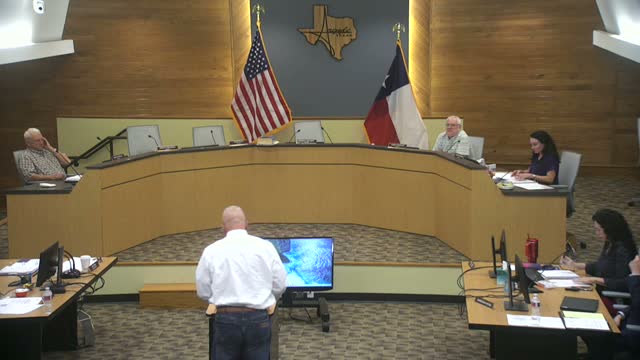
Argyle Town Council on Nov. 17 heard a multi‑firm briefing on planning for a municipal complex that could include a new police station, with firms and staff outlining cost drivers, procurement options and next steps.
Mayor summarized prior work (HDR study and a small‑area study by GFF) and said earlier cost placeholders ranged widely; preliminary hard‑cost estimates and assumptions vary by building program and market timing. Shane Williams and Brad Anderson of Poe/Pogue Construction described their experience as construction managers for public‑safety and K–12 projects, and Ted Senna explained the construction‑manager‑at‑risk (CMAR) approach for early contractor involvement and transparent cost‑tracking. Charlie Kearns of FGM Architects emphasized that code and program (storm shelter requirements, secure spaces) drive public‑safety building costs more than stylistic choices.
Jason Cave of GFF, which is under contract to complete Argyle’s facility study, said the firm needs a town‑provided budget to finish the study and proceed to procure an architect. He illustrated the point with Roanoke’s 60,000‑sf public safety project that cost about $45 million (roughly $750/sf) and said smaller municipal buildings often show higher per‑square‑foot costs due to program density and scale.
Council members asked detailed questions about square‑foot comparisons, soft costs (architectural fees, FF&E, land), and options for phasing or shell construction. Presenters cautioned that “shelling out” can save some upfront cost but may be only roughly 75% as cost‑effective as full build‑outs once systems and finishes are added. Council members emphasized fiscal caution, asking staff to return with clearer budget options before committing to an RFQ for an architect or contractor.
Staff and presenters recommended next steps: finalize a program and budget, issue an RFQ for architectural services, consider early contractor involvement to align design with budget, and explore procurement options. No procurement vote was taken at the Nov. 17 meeting; staff said they will return with budget scenarios and timelines.