Get Full Government Meeting Transcripts, Videos, & Alerts Forever!
Get email alerts on the Sustainability Certification topic
No spam. Unsubscribe anytime.
Farmers Branch committee hears case for pursuing LEED for Cities certification
Summary
Staff outlined LEED for Cities certification, its potential benefits for grants and economic development, estimated costs (registration and certification fees) and a 9–12 month timeline; staff placed $8,000 in the preliminary budget and will return with details.
Staff presented the LEED for Cities certification program and asked the Farmers Branch Sustainability Committee for feedback on pursuing the designation. A staff presenter described LEED as “a rating system for communities” that evaluates areas including transportation, water efficiency, energy and greenhouse gas emissions and quality-of-life measures.
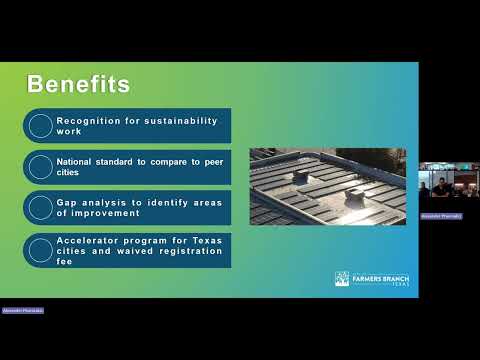
Officials said the program uses a checklist approach — policies, programs and practices earn points — and that certification would provide a score for gap analysis and national recognition. Staff noted an accelerator program for Texas cities is waiving the registration fee and could supply interns and other assistance to reduce the workload for city staff.
Committee members asked about costs and scope. Staff estimated a registration fee “around 3 grand” and said a certification fee is charged upon application completion; the certification fee was later cited at roughly $8,000. Staff also told the committee the department had placed $8,000 in the preliminary budget for the certification process. Staff described the likely timeline as nine to 12 months once work begins and said certification periods require periodic reapplication (staff estimated on the order of four years).
Members discussed the distinction between municipal operations and community-wide measures, noting that city operations typically represent a small share of community emissions; staff said some credits are based on city operations while others evaluate community metrics such as mode share. Several members said certification could strengthen future grant applications and be used to market the city to prospective businesses.
Staff characterized the LEED process as complementary to the city’s existing sustainability-plan work and recommended proceeding with further information gathering and internal coordination with the city manager’s office and finance. The committee agreed to seek more detail and to consider the budgeted $8,000 in follow-up discussions. The next procedural step, staff said, is to finalize internal budget discussions and return to council in the manner the city manager and finance recommend.