
CSLB discusses proposal to allow limited workers' compensation exemptions, keeps roofing carve-out
Get AI-powered insights, summaries, and transcripts
Subscribe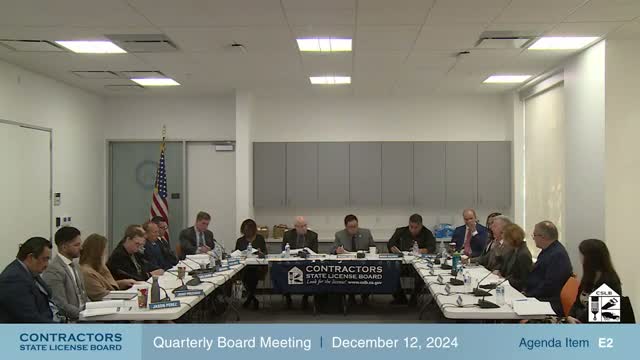
Summary
The Contractors State License Board discussed a draft bill to permit some licensees (other than C-39 roofers) to claim a workers' compensation exemption if they have no employees or projects under $5,000; the proposal would impose minimum civil penalties and certification requirements while board members raised enforcement and fraud concerns.
Dec. 12 — The Contractors State License Board spent substantial time reviewing a draft legislative proposal to permit certain licensees to claim exemptions from the state's mandatory workers' compensation requirement while retaining a prohibition for roofing contractors.
Legislative Committee Chair Joel Barton summarized the draft, saying the plan "would allow licensees, except those holding a C39 roofing classification, to file an exemption from workers compensation insurance requirements if they do not have employees or undertake construction projects valued at $5,000 or more for labor and materials." Barton added the proposal would require periodic legislative review of the $5,000 threshold and would mandate certification at renewal under penalty of perjury.
The draft would establish minimum civil penalties for violations. "Notably, this proposal would establish steep penalties for licensees who claim an exemption if it is subsequently determined they do have employees, starting at $10,000 a minimum for partnerships, LLCs, corporations, and tribal businesses," Barton said. The proposal also would block renewal or reinstatement for licensees found to have violated the rule until they procure and maintain a workers' compensation policy.
In public comment, Mark Connerly, executive director of the Roofing Contractors Association of California, thanked the board for preserving a prohibition on exemptions for C-39 roofing contractors. "That is very important to us," Connerly said, citing long-standing fights against underground economy and insurance fraud.
Board members questioned enforcement costs and the potential for renewed fraud if exemptions widen. Board member Allen Guy said enforcement "will be complicated" and noted the board would need resources to audit claims and pursue violators. Another board member called $5,000 too high for some classifications and suggested a lower exemption threshold.
Staff and enforcement representatives defended the proposal's enforcement tools. The draft would require a renewal-time questionnaire and certification "that they understand the penalties for violations of workers' compensation requirements," Joel Barton said, and enforcement staff noted existing interagency data-sharing (for example with EDD) could flag suspicious claims. Staff also said civil penalties under the proposal would return to CSLB and that more serious cases could be pursued through accusations that allow cost recovery.
No formal vote on the legislative proposal occurred during the meeting. Committee members said they would continue stakeholder engagement and seek a legislator to carry the bill and negotiate amendments as needed.
Next steps: staff will continue to refine draft language with stakeholders and return to the committee for further direction before sponsoring legislation.