CSLB advances multiple 2025 legislative items, including progress-payment penalties and enforcement minimums
Summary
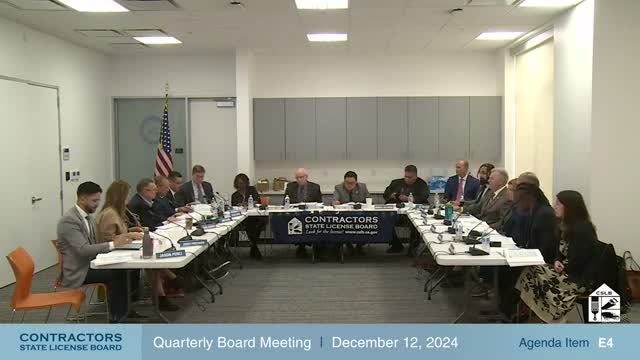
At its meeting the board voted to sponsor proposals to raise penalties for progress-payment violations, set minimum enforcement fines, limit CSLB liability on contractor cash deposits, and authorize Section 100 regulatory filings; most measures passed unanimously or with strong majorities.
The Contractors State License Board approved a package of legislative proposals and regulatory authorizations during its meeting, moving several enforcement and consumer-protection initiatives forward.
Progress-payment penalties: The board agreed to sponsor a proposal that would subject licensed or unlicensed individuals who violate progress-payment provisions to a $10,000 administrative fine when the violation causes financial injury greater than 10% of the contract price, and would allow potential license revocation for repeat or serious violations. Industry commenters warned the $10,000 penalty could be disproportionate in very small contracts: "Suppose the contract was a $5,000 project, and thus the damages would only be $500 to trigger the $10,000 penalty," a contractor representative observed. Staff responded that complaint prioritization guidelines will focus enforcement on egregious harm and that first offenses with minimal losses are less likely to result in administrative action. The board voted to sponsor the proposal (motion passed 9 to 1).
Enforcement fine minimums: To prevent administrative-law judges from reducing citation fines to amounts that do not reflect enforcement costs, the board approved a proposal to establish statutory minimum fines and to index future increases to the Consumer Price Index every five years. The motion passed unanimously (10 to 0).
Cash-deposit attorney fees: The board approved a bill to clarify that CSLB is not liable for consumer attorney fees or costs in civil cases involving a contractor's cash deposit held in lieu of a surety bond. Staff said the change responds to appellate arguments attempting to treat CSLB as a surety and that roughly 300 cash deposits are on file; the motion passed 10 to 0.
Omnibus non-substantive updates and Section 100 rulemaking: The board also approved four non-substantive statutory corrections for submission to the Senate Business Professions and Economic Development Committee for inclusion in the committee's omnibus bill, and it adopted an amendment softening a vehicle-signage disciplinary provision to say failure to comply "may constitute" cause for disciplinary action. Separately, the board authorized staff to file Section 100 (non-substantive) regulatory changes directly with the Office of Administrative Law without seeking board approval first; staff said such filings are clerical and will be reported back to the board. Those measures passed largely without opposition.
What happens next: Staff will prepare bill language, coordinate with the Department of Consumer Affairs and legislative counsel, and return to the board with updates as the proposals are carried in the Legislature.